







Question: Problem 2: Indifference Across Assets (20 Points) Suppose the representative consumer can invest in three assets nominal bonds, stocks, and physical capital. The consumer supplies
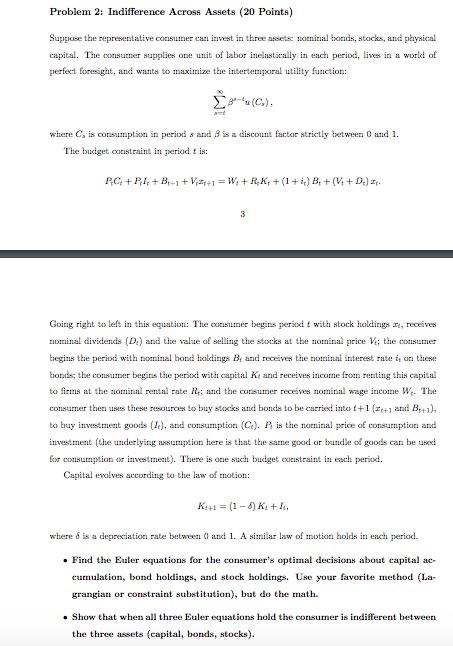
Problem 2: Indifference Across Assets (20 Points) Suppose the representative consumer can invest in three assets nominal bonds, stocks, and physical capital. The consumer supplies one unit of labor inelastically in each period, lives in a world of perfect foresight, and wants to maximize the intertemporal utility function: 3- (C). ant where C, is consumption in periods and 8 is a discount factor strictly between 0 and 1. The budget constraint in period tis: PC + P +B+1+VZ+1 = W + RK + (1 + i;) B + (V + D) zz- 3 Going right to left in this equation: The consumer begins period f with stock holdings z, receives nominal dividends (D) and the value of selling the stocks at the nominal price V; the consumer begins the period with nominal bond holdings Be and receives the nominal interest rate is on these bonds, the consumer begins the period with capital Ke and receives income from renting this capital to firms at the nominal rental rate R, and the consumer receives nominal wage income W. The consumer then uses these resources to buy stocks and bonds to be carried into f+1 (z+1 and Br+1), to buy investment goods (I), and consumption (C). P is the nominal price of consumption and investment (the underlying assumption here is that the same good or bundle of goods can be used for consumption or investment). There is one such budget constraint in each period. Capital evolves according to the law of motion: K+1 = (1-6) K + 1, where is a depreciation rate between 0 and 1. A similar law of motion holds in each period. Find the Euler equations for the consumer's optimal decisions about capital ac- cumulation, bond holdings, and stock holdings. Use your favorite method (La- grangian or constraint substitution), but do the math. Show that when all three Euler equations hold the consumer is indifferent between the three assets (capital, bonds, stocks). Problem 2: Indifference Across Assets (20 Points) Suppose the representative consumer can invest in three assets nominal bonds, stocks, and physical capital. The consumer supplies one unit of labor inelastically in each period, lives in a world of perfect foresight, and wants to maximize the intertemporal utility function: 3- (C). ant where C, is consumption in periods and 8 is a discount factor strictly between 0 and 1. The budget constraint in period tis: PC + P +B+1+VZ+1 = W + RK + (1 + i;) B + (V + D) zz- 3 Going right to left in this equation: The consumer begins period f with stock holdings z, receives nominal dividends (D) and the value of selling the stocks at the nominal price V; the consumer begins the period with nominal bond holdings Be and receives the nominal interest rate is on these bonds, the consumer begins the period with capital Ke and receives income from renting this capital to firms at the nominal rental rate R, and the consumer receives nominal wage income W. The consumer then uses these resources to buy stocks and bonds to be carried into f+1 (z+1 and Br+1), to buy investment goods (I), and consumption (C). P is the nominal price of consumption and investment (the underlying assumption here is that the same good or bundle of goods can be used for consumption or investment). There is one such budget constraint in each period. Capital evolves according to the law of motion: K+1 = (1-6) K + 1, where is a depreciation rate between 0 and 1. A similar law of motion holds in each period. Find the Euler equations for the consumer's optimal decisions about capital ac- cumulation, bond holdings, and stock holdings. Use your favorite method (La- grangian or constraint substitution), but do the math. Show that when all three Euler equations hold the consumer is indifferent between the three assets (capital, bonds, stocks)
Step by Step Solution
There are 3 Steps involved in it

Get step-by-step solutions from verified subject matter experts
 Study Help