







Question: Problem 2: informal insurance The table below shows the average production among three farmers in Oommo Nadda, a village in rural Ethiopia. On average, production
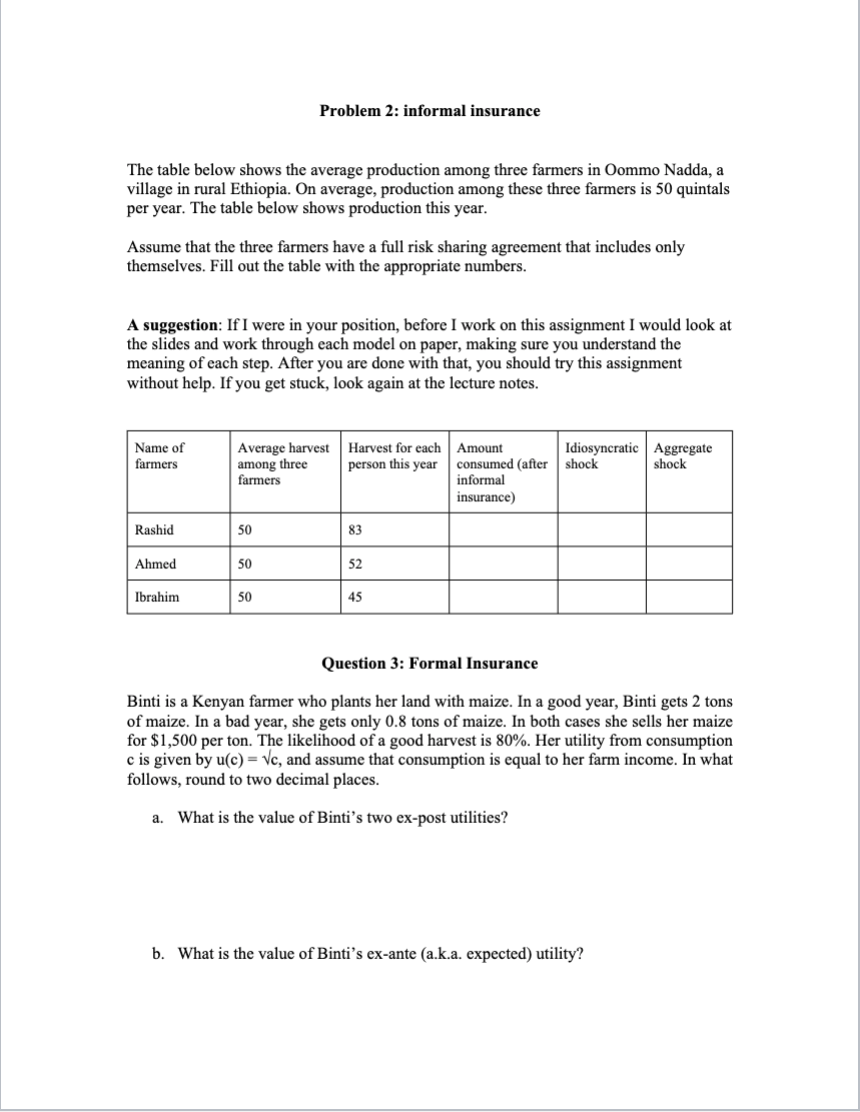
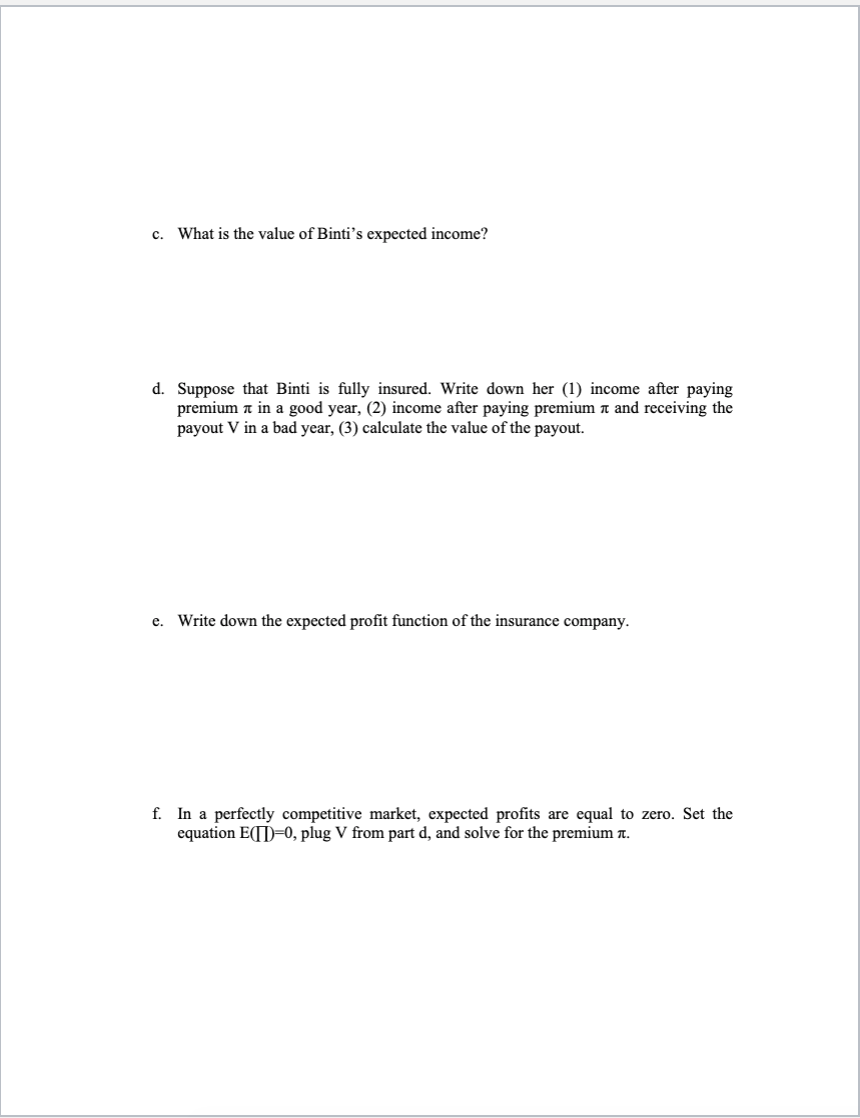
Problem 2: informal insurance The table below shows the average production among three farmers in Oommo Nadda, a village in rural Ethiopia. On average, production among these three farmers is 50 quintals per year. The table below shows production this year. Assume that the three farmers have a full risk sharing agreement that includes only themselves. Fill out the table with the appropriate numbers. A suggestion: If I were in your position, before I work on this assignment I would look at the slides and work through each model on paper, making sure you understand the meaning of each step. After you are done with that, you should try this assignment without help. If you get stuck, look again at the lecture notes. Name of farmers Average harvest among three farmers Idiosyncratic Aggregate shock shock Harvest for each Amount person this year consumed after informal insurance) Rashid 50 83 Ahmed 50 52 Ibrahim 50 45 Question 3: Formal Insurance Binti is a Kenyan farmer who plants her land with maize. In a good year, Binti gets 2 tons of maize. In a bad year, she gets only 0.8 tons of maize. In both cases she sells her maize for $1,500 per ton. The likelihood of a good harvest is 80%. Her utility from consumption c is given by u(c) = vc, and assume that consumption is equal to her farm income. In what follows, round to two decimal places. a. What is the value of Binti's two ex-post utilities? b. What is the value of Binti's ex-ante (a.k.a. expected) utility? c. What is the value of Binti's expected income? d. Suppose that Binti is fully insured. Write down her (1) income after paying premium a in a good year, (2) income after paying premium 1 and receiving the payout V in a bad year, (3) calculate the value of the payout. e. Write down the expected profit function of the insurance company. f. In a perfectly competitive market, expected profits are equal to zero. Set the equation E(TD=0, plug V from part d, and solve for the premium 1. Problem 2: informal insurance The table below shows the average production among three farmers in Oommo Nadda, a village in rural Ethiopia. On average, production among these three farmers is 50 quintals per year. The table below shows production this year. Assume that the three farmers have a full risk sharing agreement that includes only themselves. Fill out the table with the appropriate numbers. A suggestion: If I were in your position, before I work on this assignment I would look at the slides and work through each model on paper, making sure you understand the meaning of each step. After you are done with that, you should try this assignment without help. If you get stuck, look again at the lecture notes. Name of farmers Average harvest among three farmers Idiosyncratic Aggregate shock shock Harvest for each Amount person this year consumed after informal insurance) Rashid 50 83 Ahmed 50 52 Ibrahim 50 45 Question 3: Formal Insurance Binti is a Kenyan farmer who plants her land with maize. In a good year, Binti gets 2 tons of maize. In a bad year, she gets only 0.8 tons of maize. In both cases she sells her maize for $1,500 per ton. The likelihood of a good harvest is 80%. Her utility from consumption c is given by u(c) = vc, and assume that consumption is equal to her farm income. In what follows, round to two decimal places. a. What is the value of Binti's two ex-post utilities? b. What is the value of Binti's ex-ante (a.k.a. expected) utility? c. What is the value of Binti's expected income? d. Suppose that Binti is fully insured. Write down her (1) income after paying premium a in a good year, (2) income after paying premium 1 and receiving the payout V in a bad year, (3) calculate the value of the payout. e. Write down the expected profit function of the insurance company. f. In a perfectly competitive market, expected profits are equal to zero. Set the equation E(TD=0, plug V from part d, and solve for the premium 1
Step by Step Solution
There are 3 Steps involved in it

Get step-by-step solutions from verified subject matter experts
 Study Help