







Question: Problem 2: Isolation Levels and Locking (20 points) Given two transactions T, and T2 operating on database objects: A, B, and C. Consider the following
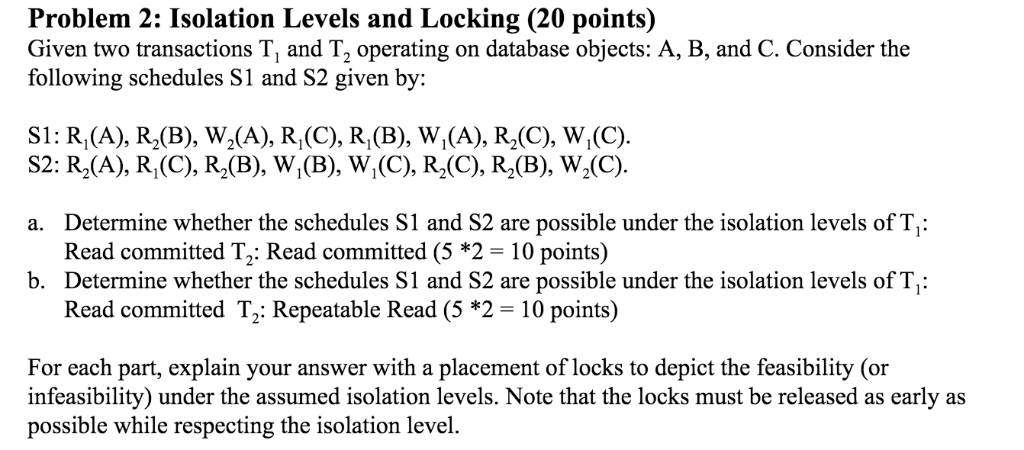
Problem 2: Isolation Levels and Locking (20 points) Given two transactions T, and T2 operating on database objects: A, B, and C. Consider the following schedules S1 and S2 given by: S1: R,(A), R2(B), W2(A), R,(C), R,(B), W,(A), R2(C), W,(C). S2: R2(A), R,(C), R2(B), W(B), W,(C), R2(C), R(B), W2(C). a. Determine whether the schedules S1 and S2 are possible under the isolation levels of T: Read committed T2: Read committed (5 *2 - 10 points) b. Determine whether the schedules S1 and S2 are possible under : the isolation levels of T Read committed T,: Repeatable Read (5 *2-10 points) For each part, explain your answer with a placement of locks to depict the feasibility (or infeasibility) under the assumed isolation levels. Note that the locks must be released as early as possible while respecting the isolation level. Problem 2: Isolation Levels and Locking (20 points) Given two transactions T, and T2 operating on database objects: A, B, and C. Consider the following schedules S1 and S2 given by: S1: R,(A), R2(B), W2(A), R,(C), R,(B), W,(A), R2(C), W,(C). S2: R2(A), R,(C), R2(B), W(B), W,(C), R2(C), R(B), W2(C). a. Determine whether the schedules S1 and S2 are possible under the isolation levels of T: Read committed T2: Read committed (5 *2 - 10 points) b. Determine whether the schedules S1 and S2 are possible under : the isolation levels of T Read committed T,: Repeatable Read (5 *2-10 points) For each part, explain your answer with a placement of locks to depict the feasibility (or infeasibility) under the assumed isolation levels. Note that the locks must be released as early as possible while respecting the isolation level
Step by Step Solution
There are 3 Steps involved in it

Get step-by-step solutions from verified subject matter experts
 Study Help