







Question: Problem 2. Let M = (Q, E, 6, qo, F) be a DFA and consider the DFA M' = (Q, E, 8, qo, Q

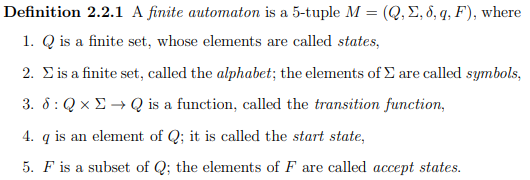
Problem 2. Let M = (Q, E, 6, qo, F) be a DFA and consider the DFA M' = (Q, E, 8, qo, Q \ F). Is it always true that L(M') = L(M) = E* \ L(M)? What if one took a NFA N = (Q,E, 8, q0, F') and built a NFA N' = (Q,E, 8, qo, Q\F)? Would it always be true that L(N') = L(N)? Prove that your answers are correct. Definition 2.2.1 A finite automaton is a 5-tuple M = (Q, E, 8, q, F'), where %3D 1. Q is a finite set, whose elements are called states, 2. E is a finite set, called the alphabet; the elements of E are called symbols, 3. 8: Q x E Q is a function, called the transition function, 4. q is an element of Q; it is called the start state, 5. F is a subset of Q; the elements of F are called accept states
Step by Step Solution
There are 3 Steps involved in it

Get step-by-step solutions from verified subject matter experts
 Study Help