







Question: Problem 2 Let's say, instead, that the tes isa adaptive you get to answer more questions based o your pevous sccess. This test is -
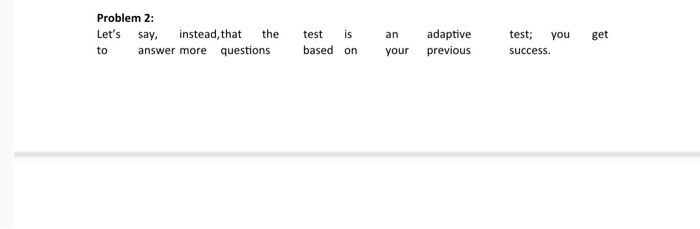
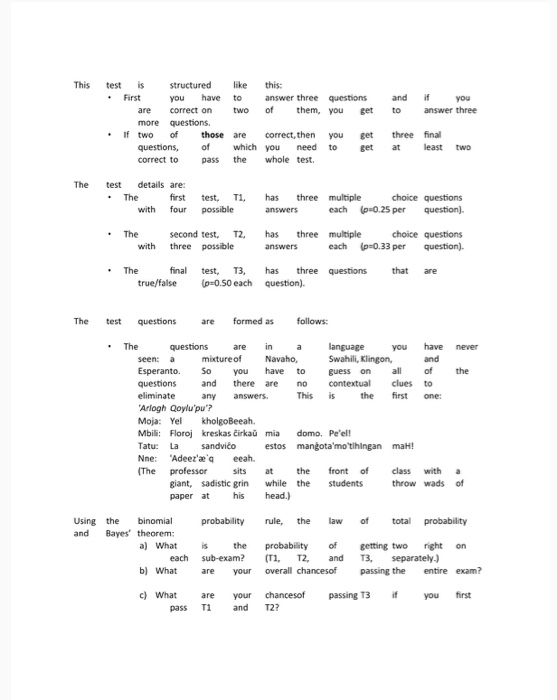
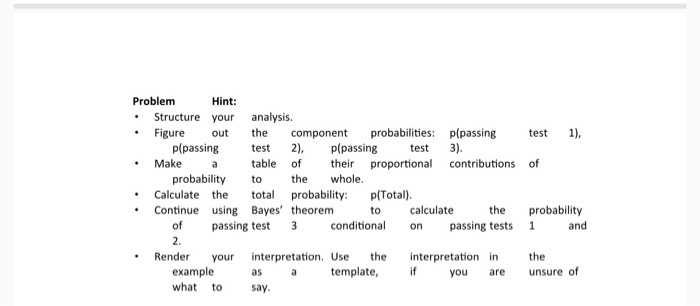
Problem 2 Let's say, instead, that the tes isa adaptive you get to answer more questions based o your pevous sccess. This test is - First and if are correct on two of them, you getto answer three .If two of those are correct, then you get three final questions, of whchyou need to et east two The test details are .The first test, , three multiple each (p-0.25 per question). The second test, T2, three multiple each (p-0.33 per question). The final test, T3, th true/false p0.50 each question). questions that are The test questionsare formed as follows The questions are in languageyou have never Swahili, Klingon, seen: a Esperanto. oyou have to guess on of the questions and there are no contextual cles to any answers This is Mbili: Floroj kreskas irkau mia domo. Pe'el! estos mangota mo tihingan maH! (The professor is at the front of with a probability rule, the law of total probability Using the binomial and Bayes theorem: a) Whattprobability getting two right on each sub-exam (T. T2 and T3, separately.) passing the entire exami? c) What are your chancesof passing T3 if Problem Hint Structure your analysis. Figure the component probabilities: p(passing test 1), p(passing 2),p(passing t 3) Make atable of proportional contributions of probability twhole. Calculate the probability: p(Total) Continue using Bayes theorem probability conditional o passing tests1 and to calculate t of passing test 2. Render your interpretation. Use nterpretation in the example what to say eplate, if you are unsure of Problem 2 Let's say, instead, that the tes isa adaptive you get to answer more questions based o your pevous sccess. This test is - First and if are correct on two of them, you getto answer three .If two of those are correct, then you get three final questions, of whchyou need to et east two The test details are .The first test, , three multiple each (p-0.25 per question). The second test, T2, three multiple each (p-0.33 per question). The final test, T3, th true/false p0.50 each question). questions that are The test questionsare formed as follows The questions are in languageyou have never Swahili, Klingon, seen: a Esperanto. oyou have to guess on of the questions and there are no contextual cles to any answers This is Mbili: Floroj kreskas irkau mia domo. Pe'el! estos mangota mo tihingan maH! (The professor is at the front of with a probability rule, the law of total probability Using the binomial and Bayes theorem: a) Whattprobability getting two right on each sub-exam (T. T2 and T3, separately.) passing the entire exami? c) What are your chancesof passing T3 if Problem Hint Structure your analysis. Figure the component probabilities: p(passing test 1), p(passing 2),p(passing t 3) Make atable of proportional contributions of probability twhole. Calculate the probability: p(Total) Continue using Bayes theorem probability conditional o passing tests1 and to calculate t of passing test 2. Render your interpretation. Use nterpretation in the example what to say eplate, if you are unsure of
Step by Step Solution
There are 3 Steps involved in it

Get step-by-step solutions from verified subject matter experts
 Study Help