







Question: Problem # 2 Let's take a look at how your friend with the snowboarding accident from last homework is doing. Unfortunately, the first rescue helicopter
Problem #
Let's take a look at how your friend with the snowboarding accident from last homework is doing. Unfortunately, the first rescue helicopter had a rotor issue and needed to return your friend to the ground. A second helicopter arrives to transport your friend. Upon realizing that they have forgotten their standard rescue line, they fashion a makeshift line from a bungee cord, which behaves like a spring with no damping.
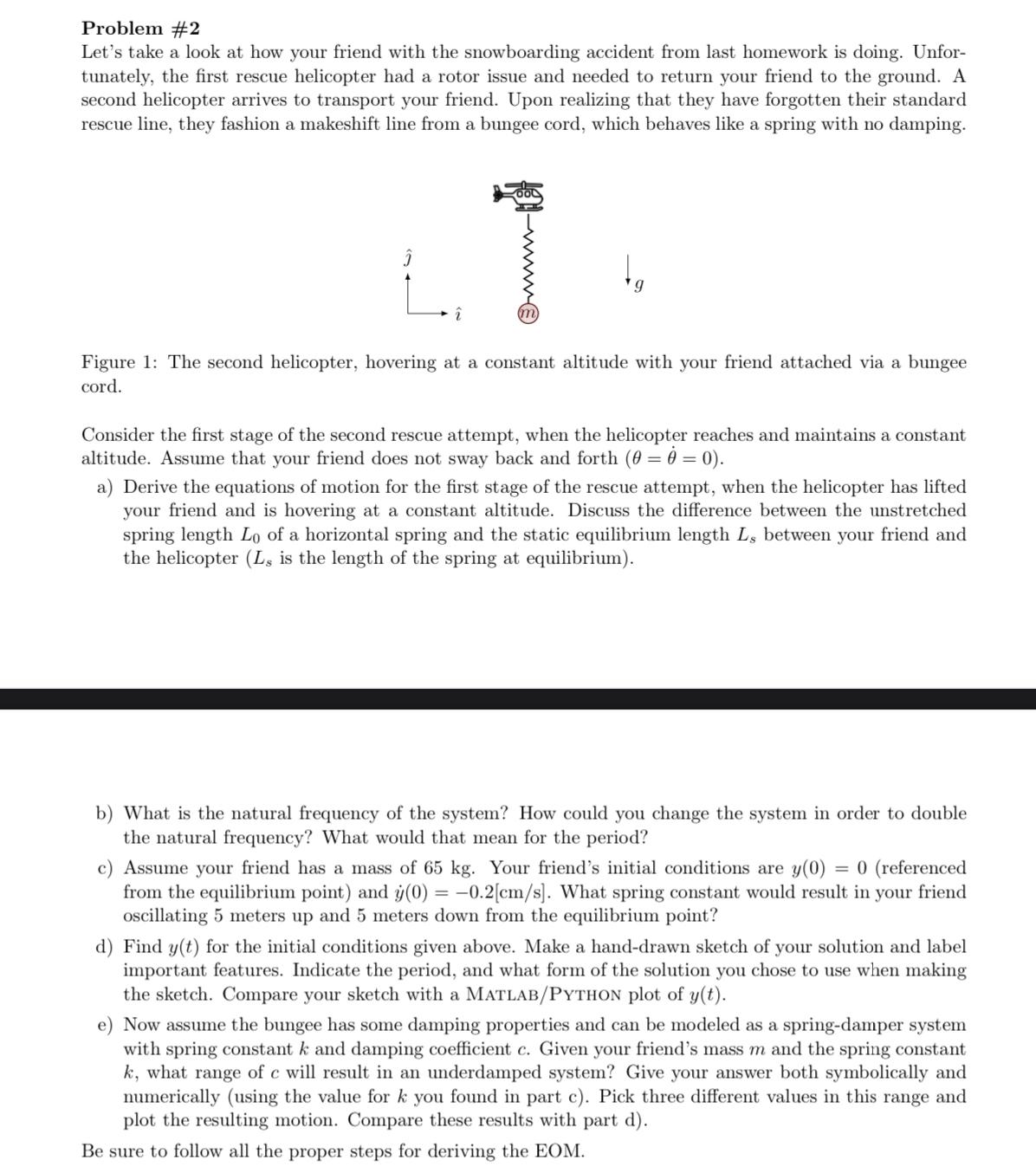
Figure : The second helicopter, hovering at a constant altitude with your friend attached via a bungee cord.
Consider the first stage of the second rescue attempt, when the helicopter reaches and maintains a constant altitude. Assume that your friend does not sway back and forth
a Derive the equations of motion for the first stage of the rescue attempt, when the helicopter has lifted your friend and is hovering at a constant altitude. Discuss the difference between the unstretched spring length of a horizontal spring and the static equilibrium length between your friend and the helicopter is the length of the spring at equilibrium
b What is the natural frequency of the system? How could you change the system in order to double the natural frequency? What would that mean for the period?
c Assume your friend has a mass of Your friend's initial conditions are referenced from the equilibrium point and What spring constant would result in your friend oscillating meters up and meters down from the equilibrium point?
d Find for the initial conditions given above. Make a handdrawn sketch of your solution and label important features. Indicate the period, and what form of the solution you chose to use when making the sketch. Compare your sketch with a MATLABPYTHON plot of
e Now assume the bungee has some damping properties and can be modeled as a springdamper system with spring constant and damping coefficient Given your friend's mass and the spring constant what range of will result in an underdamped system? Give your answer both symbolically and numerically using the value for you found in part c Pick three different values in this range and plot the resulting motion. Compare these results with part d
Be sure to follow all the proper steps for deriving the EOM.
Step by Step Solution
There are 3 Steps involved in it
1 Expert Approved Answer
Step: 1 Unlock

Question Has Been Solved by an Expert!
Get step-by-step solutions from verified subject matter experts
Step: 2 Unlock
Step: 3 Unlock
 Study Help