







Question: Problem 2. Matching Pennies (35 points) Setup This problem is based in part on Goeree and Holt (2001). We say that a game is a
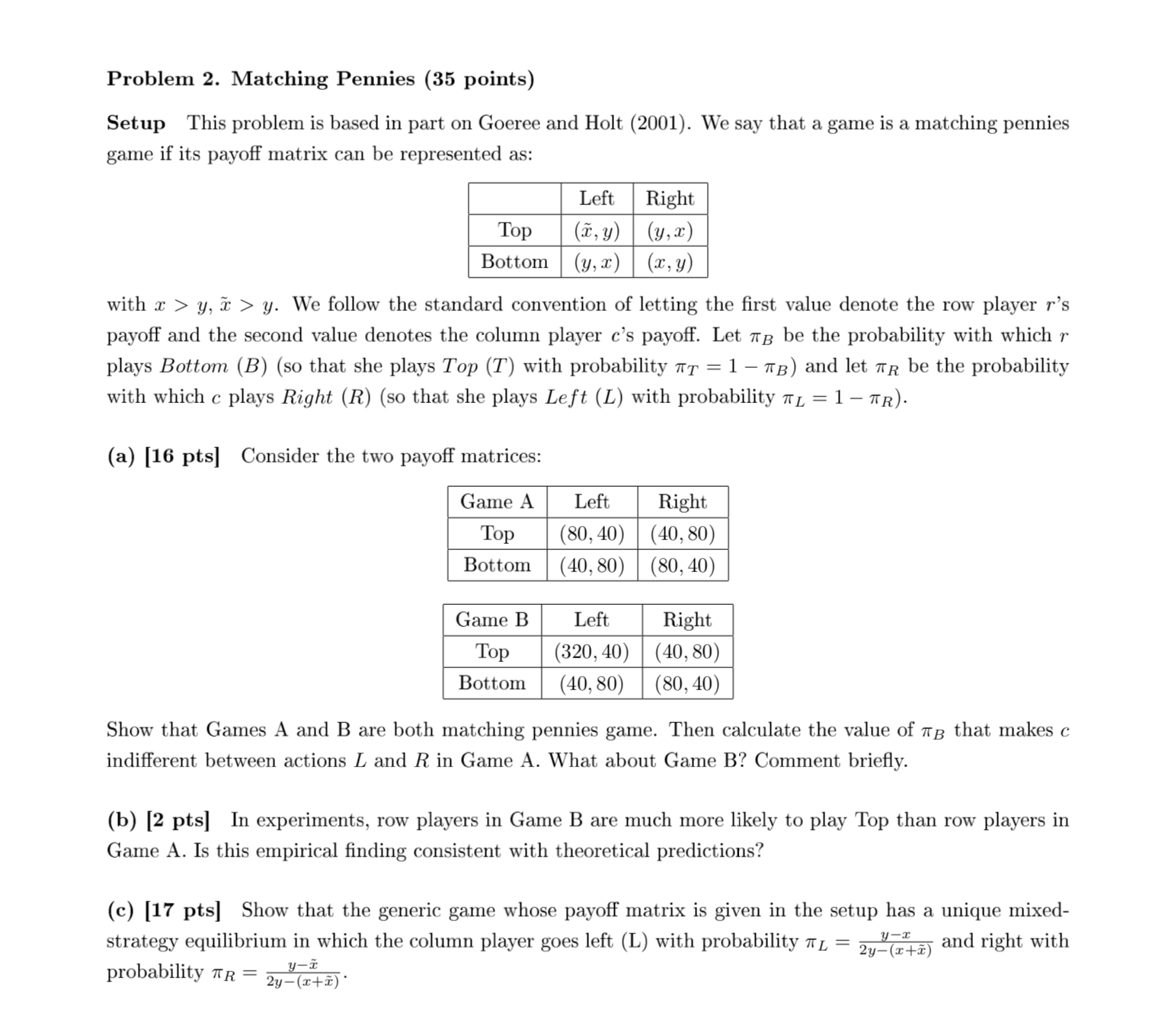
Problem 2. Matching Pennies (35 points) Setup This problem is based in part on Goeree and Holt (2001). We say that a game is a matching pennies game if its payoff matrix can be represented as: with :c > y, :7: > y. We follow the standard convention of letting the rst value denote the row player r's payoff and the second value denotes the column player c's payoff. Let 7r); be the probability with which r plays Bottom (B) (so that she plays Top (T) with probability arr = 1 arg) and let 71'}; be the probability with which 6 plays Right (R) (so that she plays Left (L) with probability 1rL = 1 7TH). (a) [16 pts] Consider the two payoff matrices: (80,40) (40,80) (40,80) (80,40) Top (320, 40) (40, 80) (40, 80) (80, 40) Show that Games A and B are both matching pennies game. Then calculate the value of in; that makes (3 indifferent between actions L and R in Game A. What about Game B? Comment briey. (b) [2 pts] In experiments, row players in Game B are much more likely to play Top than row players in Game A. Is this empirical nding consistent with theoretical predictions? (c) [17 pts] Show that the generic game whose payolf matrix is given in the setup has a unique mixed strategy equilibrium in which the column player goes left (L) with probability 7rL : and right with probability 7m = 5%\" _.'_3_ 2y(m+a'c)
Step by Step Solution
There are 3 Steps involved in it

Get step-by-step solutions from verified subject matter experts
 Study Help