







Question: Problem 2: n-DES Recall the Data Encryption Standard (DES) and the meet-in-the-middle attack. Note: function DES) denotes the encryption of a block using DES. .
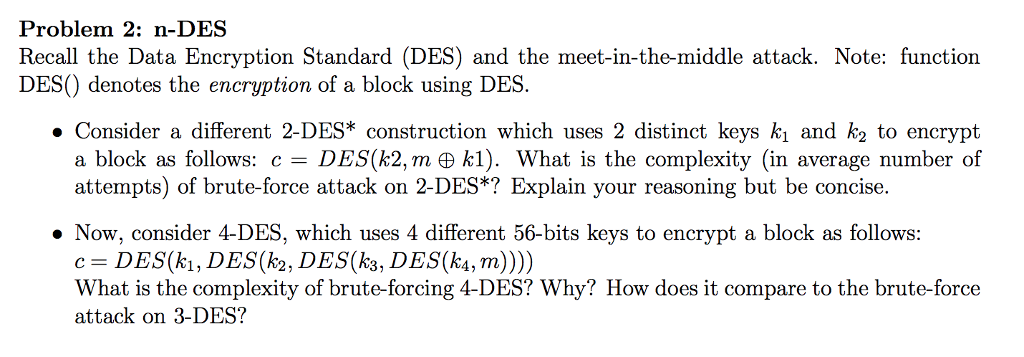
Problem 2: n-DES Recall the Data Encryption Standard (DES) and the meet-in-the-middle attack. Note: function DES) denotes the encryption of a block using DES. . Consider a different 2-DES* construction which uses 2 distinct keys k and k2 to encrypt a block as follows: c-DES(k2.m k1). What is the complexity (in average number of attempts) of brute-force attack on 2-DES*? Explain your reasoning but be concise. Now, consider 4-DES, which uses 4 different 56-bits keys to encrypt a block as follows: c = DES(k1, DES(k2, DES(k3, DES(k4m)))) What is the complexity of brute-forcing 4-DES? Why? How does it compare to the brute-force attack on 3-DES? Problem 2: n-DES Recall the Data Encryption Standard (DES) and the meet-in-the-middle attack. Note: function DES) denotes the encryption of a block using DES. . Consider a different 2-DES* construction which uses 2 distinct keys k and k2 to encrypt a block as follows: c-DES(k2.m k1). What is the complexity (in average number of attempts) of brute-force attack on 2-DES*? Explain your reasoning but be concise. Now, consider 4-DES, which uses 4 different 56-bits keys to encrypt a block as follows: c = DES(k1, DES(k2, DES(k3, DES(k4m)))) What is the complexity of brute-forcing 4-DES? Why? How does it compare to the brute-force attack on 3-DES
Step by Step Solution
There are 3 Steps involved in it

Get step-by-step solutions from verified subject matter experts
 Study Help