







Question: Problem 2 : ( Question 7 . 1 from the textbook ) Assume that we have a Poisson arrival process with = 0 . 9
Problem : Question from the textbook
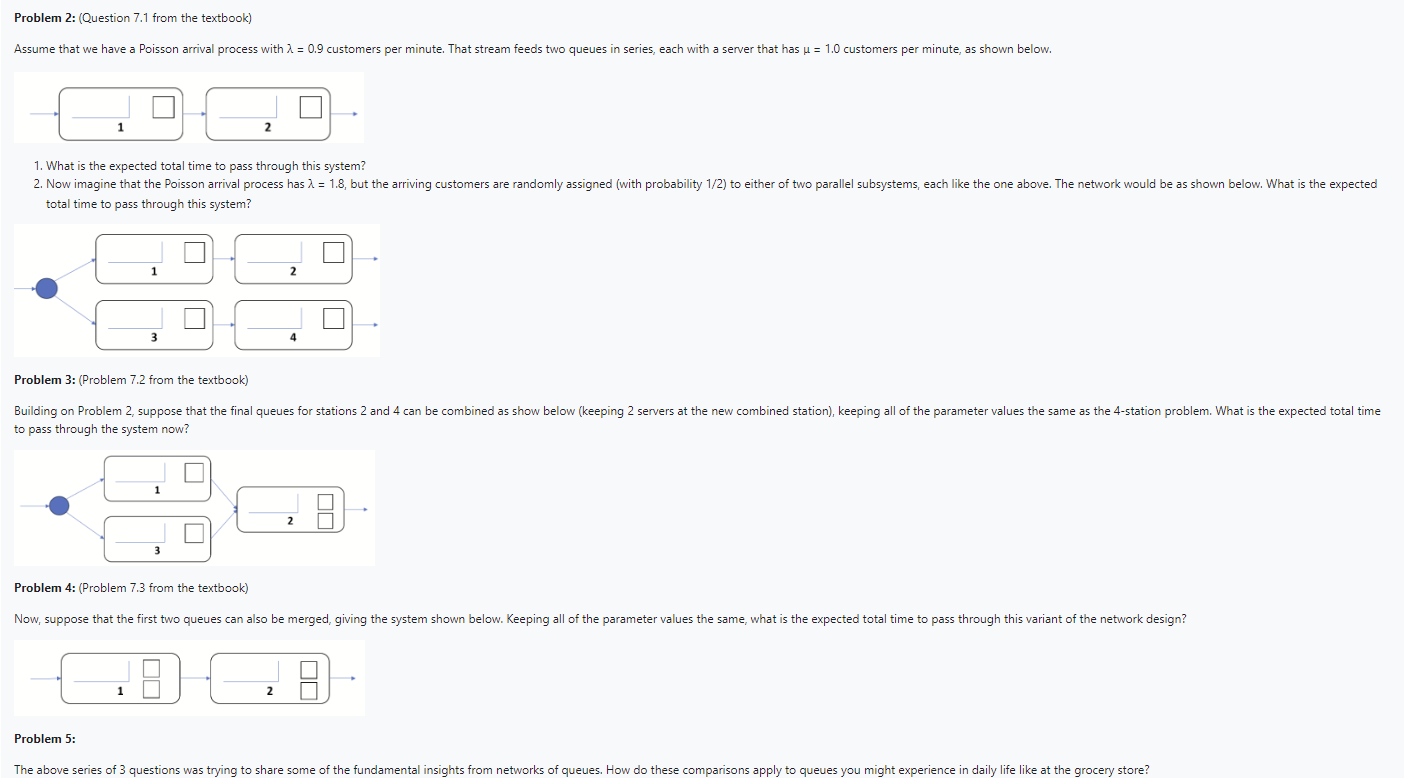
Assume that we have a Poisson arrival process with customers per minute. That stream feeds two queues in series, each with a server that has customers per minute, as shown below.
What is the expected total time to pass through this system?
Now imagine that the Poisson arrival process has but the arriving customers are randomly assigned with probability to either of two parallel subsystems, each like the one above. The network would be as shown below. What is the expected total time to pass through this system?
Problem : Problem from the textbook
Building on Problem suppose that the final queues for stations and can be combined as show below keeping servers at the new combined station keeping all of the parameter values the same as the station problem. What is the expected total time to pass through the system now?
Problem : Problem from the textbook
Now, suppose that the first two queues can also be merged, giving the system shown below. Keeping all of the parameter values the same, what is the expected total time to pass through this variant of the network design?
Problem :
The above series of questions was trying to share some of the fundamental insights from networks of queues. How do these comparisons apply to queues you might experience in daily life like at the grocery store? Problem : Question from the textbook
Assume that we have a Poisson arrival process with lambda customers per minute. That stream feeds two queues in series, each with a server that has mu customers per minute, as shown below.
What is the expected total time to pass through this system? total time to pass through this system?
Problem : Problem from the textbook to pass through the system now?
Problem : Problem from the textbook
Now, suppose that the first two queues can also be merged, giving the system shown below. Keeping all of the parameter values the same, what is the expected total time to pass through this variant of the network design?
Problem :
The above series of questions was trying to share some of the fundamental insights from networks of queues. How do these comparisons apply to queues you might experience in daily life like at the grocery store?
Step by Step Solution
There are 3 Steps involved in it
1 Expert Approved Answer
Step: 1 Unlock

Question Has Been Solved by an Expert!
Get step-by-step solutions from verified subject matter experts
Step: 2 Unlock
Step: 3 Unlock
 Study Help