







Question: Problem 2 - Refrigerator Cycle An ideal vapor - compression refrigeration cycle that uses refrigerant 1 3 4 - a as its working fluid maintains
Problem Refrigerator Cycle
An ideal vaporcompression refrigeration cycle that uses refrigerant a as its working fluid maintains a condenser at kPa and the evaporator at circmathrmC Determine:
a the amount of power required to service a kW cooling load, and
b the system's COP. Problem Otto Cycle Octane vs Hydrogen
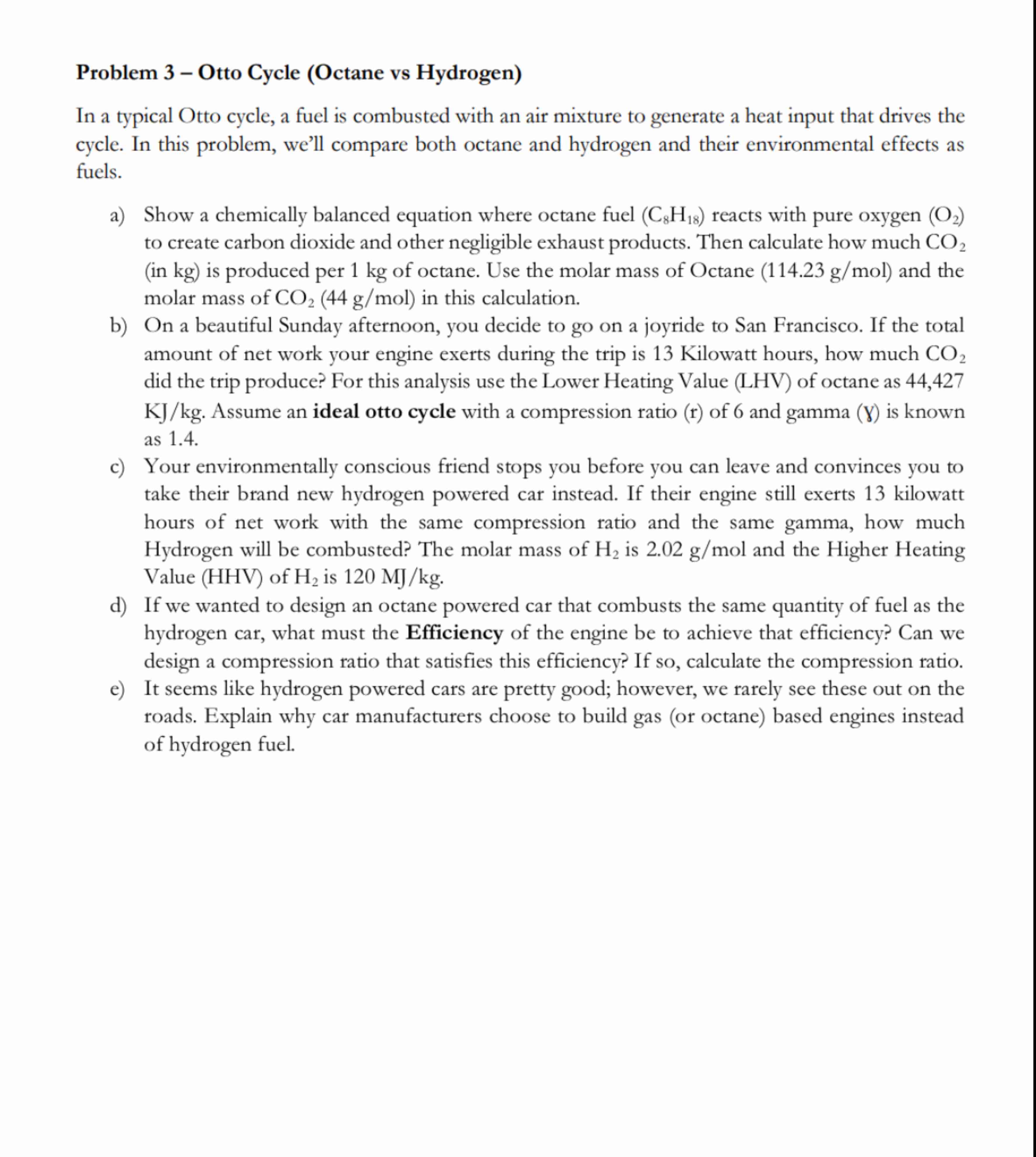
In a typical Otto cycle, a fuel is combusted with an air mixture to generate a heat input that drives the cycle. In this problem, we'll compare both octane and hydrogen and their environmental effects as fuels.
a Show a chemically balanced equation where octane fuel leftmathrmCmathrmHright reacts with pure oxygen leftmathrmOright to create carbon dioxide and other negligible exhaust products. Then calculate how much mathrmCOin kg is produced per kg of octane. Use the molar mass of Octane mathrm~gmathrmmol and the molar mass of mathrmCOmathrm~gmathrmmol in this calculation.
b On a beautiful Sunday afternoon, you decide to go on a joyride to San Francisco. If the total amount of net work your engine exerts during the trip is Kilowatt hours, how much mathrmCO did the trip produce? For this analysis use the Lower Heating Value LHV of octane as mathrmKJmathrmkg Assume an ideal otto cycle with a compression ratio r of and gamma gamma is known as
c Your environmentally conscious friend stops you before you can leave and convinces you to take their brand new hydrogen powered car instead. If their engine still exerts kilowatt hours of net work with the same compression ratio and the same gamma, how much Hydrogen will be combusted? The molar mass of mathrmH is mathrm~gmathrmmol and the Higher Heating Value HHV of mathrmH is mathrmMJmathrmkg
d If we wanted to design an octane powered car that combusts the same quantity of fuel as the hydrogen car, what must the Efficiency of the engine be to achieve that efficiency? Can we design a compression ratio that satisfies this efficiency? If so calculate the compression ratio.
e It seems like hydrogen powered cars are pretty good; however, we rarely see these out on the roads. Explain why car manufacturers choose to build gas or octane based engines instead of hydrogen fuel. Problem Otto Cycle Octane vs Hydrogen
In a typical Otto cycle, a fuel is combusted with an air mixture to generate a heat input that drives the cycle. In this problem, we'll compare both octane and hydrogen and their environmental effects as fuels.
a Show a chemically balanced equation where octane fuel leftmathrmCmathrmHright reacts with pure oxygen leftmathrmOright to create carbon dioxide and other negligible exhaust products. Then calculate how much mathrmCOin kg is produced per kg of octane. Use the molar mass of Octane mathrm~gmathrmmol and the molar mass of mathrmCOmathrm~gmathrmmol in this calculation.
b On a beautiful Sunday afternoon, you decide to go on a joyride to San Francisco. If the total amount of net work your engine exerts during the trip is Kilowatt hours, how much mathrmCO did the trip produce? For this analysis use the Lower Heating Value LHV of octane as mathrmKJmathrmkg Assume an ideal otto cycle with a compression ratio r of and gamma mathrmgamma is known as
c Your environmentally conscious friend stops you before you can leave and convinces you to take their brand new hydrogen powered car instead. If their engine still exerts kilowatt hours of net work with the same compression ratio and the same gamma, how much Hydrogen will be combusted? The molar mass of mathrmH is mathrm~gmathrmmol and the Higher Heating Value HHV of mathrmH is mathrmMJmathrmkg
d If we wanted to design an octane powered car that combusts the same quantity of fuel as the hydrogen car, what must the Efficiency of the engine be to achieve that efficiency? Can we design a compression ratio that satisfies this efficiency? If so calculate the compression ratio.
e It seems like hydrogen powered cars are pretty good; however, we rarely see these out on the roads. Explain why car manufacturers choose to build gas or octane based engines instead of hydrogen fuel.
Step by Step Solution
There are 3 Steps involved in it
1 Expert Approved Answer
Step: 1 Unlock

Question Has Been Solved by an Expert!
Get step-by-step solutions from verified subject matter experts
Step: 2 Unlock
Step: 3 Unlock
 Study Help