







Question: Problem 2 - Relations and Preferences (T marks total, 1 mark for each item) Consider & decision-maker {DM) having to chocse a single deterministic alternative
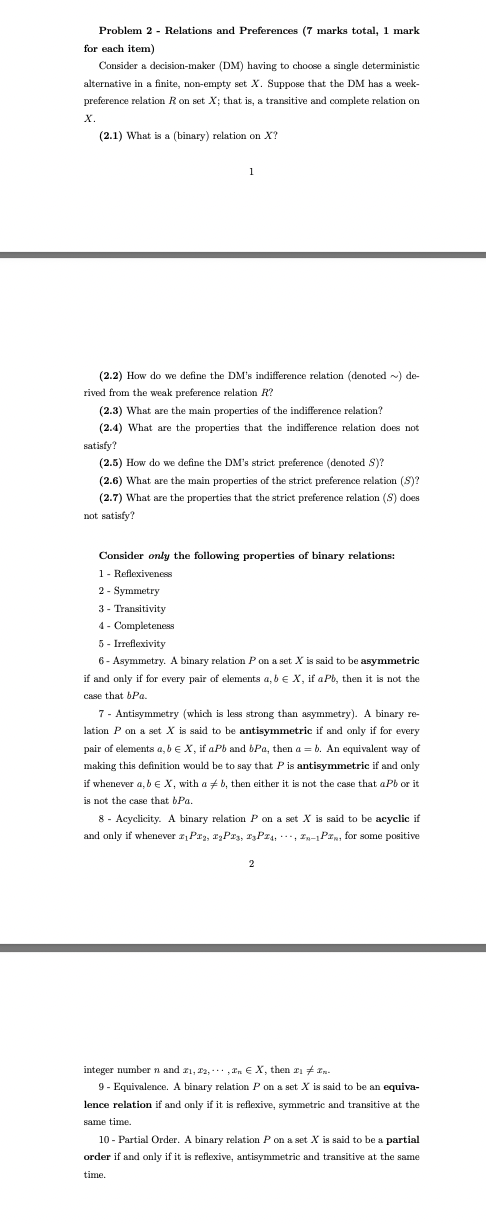
Problem 2 - Relations and Preferences (T marks total, 1 mark for each item) Consider & decision-maker {DM) having to chocse a single deterministic alternative in a finite, non-empty set X. Suppose that the DM has a week- preference relation # on set X that is, a transitive and complete relation on X. (2.1) What is a (binary) relation on X7 (2.2) How do we define the DM's indifference relation (denoted ~) de- rived from the weak preforence relation R? (2.3) What are the main properties of the indifference relation? (2.4) What are the properties that the indifference relation does not satisfy? (2.5) How do we define the DM's strict. preference (denoted 5)7 (2.6) What are the main properties of the strict preference relation ()7 (2.7) What are the properties that the strict preference relation (5] does not satisfy? Consider only the following properties of binary relations: 1 - Reflexiveness 2 - Symmetry 3 - Transitivity 4 - Completeness 5 - Irreflexivity 6 - Asymmetry. A binary relation P on aset X is said to be asymmetric if and only if for every pair of elements a,b X, if aPb, then it is not the case that bPa. 7 - Antisymmetry (which is less strong than asymmetry). A binary re- lation P on a set X is said to be antisymmetric if and only if for every pair of elements o, b X, if aPb and #Pa, then a = b An equivalent way of making this definition would be to say that P is antisymmetric if and only if whenever @, b X, with a # b, then either it is not the case that aPh or it 18 not the case that bFa. & - Acwelicity. A binary relation P on a set X is said to be acyclic if and only if whenever ) Pxy, 3P1q, 1Py, + -, , Pz, for some positive 2 integer number n and y, 2.+ 2o X, then 1) # z.. 9 - Equivalence. A binary relation P on a set X is said to be an equiva- lence relation if and oaly if it is reflexive, symmetric and transitive at the same time. 10 - Partial Order. A binary relation /* on aset X is said to be a partial order if and only if it is reflexive, antisymmetric and transitive at the same time
Step by Step Solution
There are 3 Steps involved in it

Get step-by-step solutions from verified subject matter experts
 Study Help