







Question: = Problem 2 (Rollercoaster Sequences). (30 points) You are given a sequence of numbers a[1..n). A rollercoaster sequence of level k b[1..m] is a subsequence
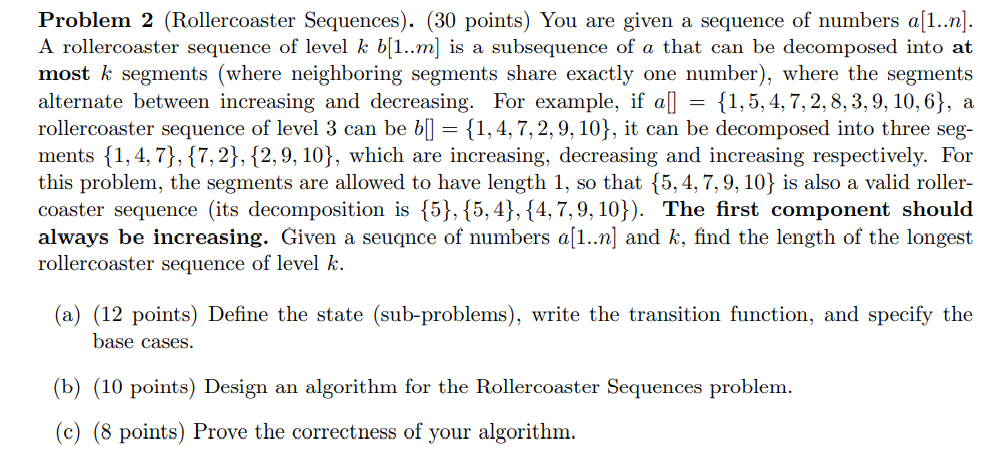
= Problem 2 (Rollercoaster Sequences). (30 points) You are given a sequence of numbers a[1..n). A rollercoaster sequence of level k b[1..m] is a subsequence of a that can be decomposed into at most k segments (where neighboring segments share exactly one number), where the segments alternate between increasing and decreasing. For example, if a[] = {1,5, 4, 7, 2,8, 3, 9, 10,6}, a rollercoaster sequence of level 3 can be b[] = {1,4, 7, 2, 9, 10}, it can be decomposed into three seg- ments {1,4,7}, {7, 2}, {2, 9, 10}, which are increasing, decreasing and increasing respectively. For this problem, the segments are allowed to have length 1, so that {5, 4, 7, 9, 10} is also a valid roller- coaster sequence (its decomposition is {5}, {5,4}, {4, 7, 9, 10}). The first component should always be increasing. Given a seuqnce of numbers a[1..n) and k, find the length of the longest rollercoaster sequence of level k. (a) (12 points) Define the state (sub-problems), write the transition function, and specify the base cases. (b) (10 points) Design an algorithm for the Rollercoaster Sequences problem. (c) (8 points) Prove the correctness of your algorithm
Step by Step Solution
There are 3 Steps involved in it

Get step-by-step solutions from verified subject matter experts
 Study Help