







Question: Problem 2: Rubik's Cube Grading criteria: code correctness. a. Imagine a version of Rubik's Cube in which only the relative positions of the 27 cubelets
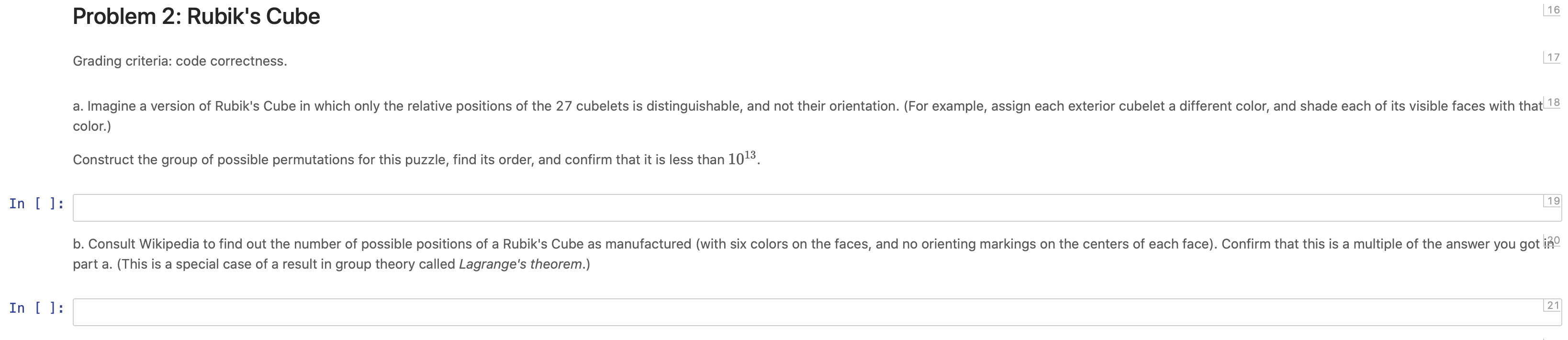
Problem 2: Rubik's Cube Grading criteria: code correctness. a. Imagine a version of Rubik's Cube in which only the relative positions of the 27 cubelets is distinguishable, and not their orientation. (For example, assign each exterior cubelet a different color, and shade each of its visible faces with that 18 color.) Construct the group of possible permutations for this puzzle, find its order, and confirm that it is less than 1013. In [ ]: b. Consult Wikipedia to find out the number of possible positions of a Rubik's Cube as manufactured (with six colors on the faces, and no orienting markings on the centers of each face). Confirm that this is a multiple of the answer you got ino part a. (This is a special case of a result in group theory called Lagrange's theorem.) In [ ]: Problem 2: Rubik's Cube Grading criteria: code correctness. a. Imagine a version of Rubik's Cube in which only the relative positions of the 27 cubelets is distinguishable, and not their orientation. (For example, assign each exterior cubelet a different color, and shade each of its visible faces with that 18 color.) Construct the group of possible permutations for this puzzle, find its order, and confirm that it is less than 1013. In [ ]: b. Consult Wikipedia to find out the number of possible positions of a Rubik's Cube as manufactured (with six colors on the faces, and no orienting markings on the centers of each face). Confirm that this is a multiple of the answer you got ino part a. (This is a special case of a result in group theory called Lagrange's theorem.) In [ ]
Step by Step Solution
There are 3 Steps involved in it

Get step-by-step solutions from verified subject matter experts
 Study Help