







Question: Problem 2: Simulation In a restaurant kitchen, orders arrive randomly from 09:00 - 22:00 (13 hours); the time between two consecutive orders arriving follows an
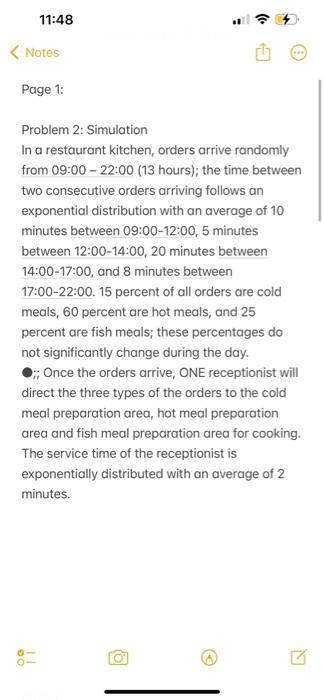
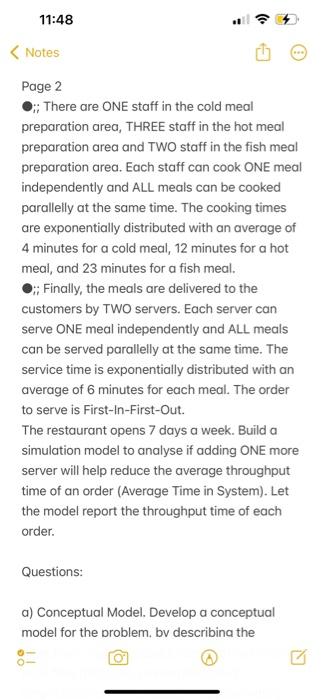
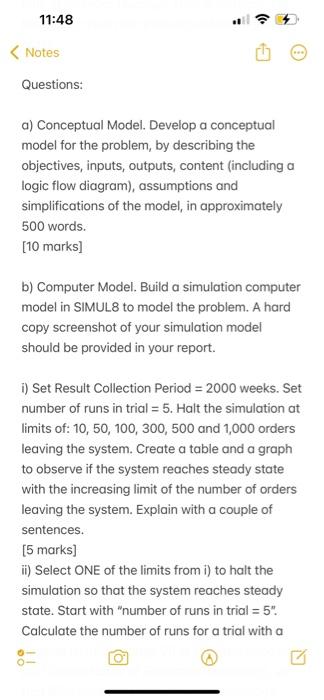
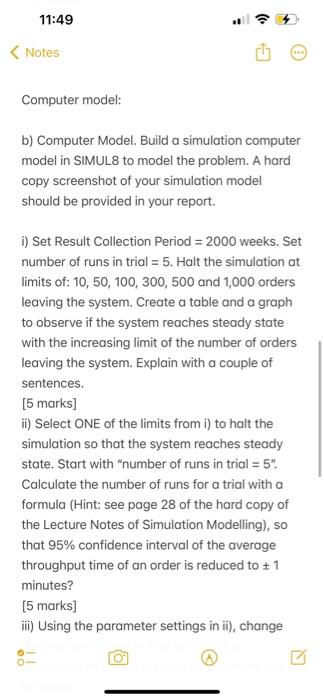
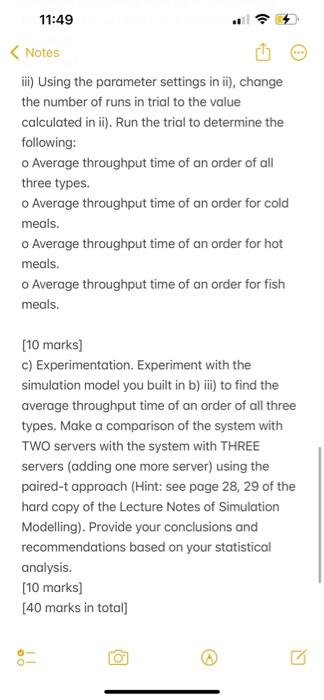
Problem 2: Simulation In a restaurant kitchen, orders arrive randomly from 09:00 - 22:00 (13 hours); the time between two consecutive orders arriving follows an exponential distribution with an average of 10 minutes between 09:00-12:00, 5 minutes between 12:00-14:00, 20 minutes between 14:00-17:00, and 8 minutes between 17:00-22:00. 15 percent of all orders are cold meals, 60 percent are hot meals, and 25 percent are fish meals; these percentages do not significantly change during the day. -; Once the orders arrive, ONE receptionist will direct the three types of the orders to the cold meal preparation area, hot meal preparation area and fish meal preparation area for cooking. The service time of the receptionist is exponentially distributed with an average of 2 minutes. Page 2 -;i There are ONE staff in the cold meal preparation area, THREE staff in the hot meal preparation area and TWO staff in the fish meal preparation area. Each staff can cook ONE meal independently and ALL meals can be cooked parallelly at the same time. The cooking times are exponentially distributed with an average of 4 minutes for a cold meal, 12 minutes for a hot meal, and 23 minutes for a fish meal. -;i Finally, the meals are delivered to the customers by TWO servers. Each server can serve ONE meal independently and ALL meals can be served parallelly at the same time. The service time is exponentially distributed with an average of 6 minutes for each meal. The order to serve is First-In-First-Out. The restaurant opens 7 days a week. Build a simulation model to analyse if adding ONE more server will help reduce the average throughput time of an order (Average Time in System). Let the model report the throughput time of each order. Questions: a) Conceptual Model. Develop a conceptual model for the problem, bv describina the Questions: a) Conceptual Model. Develop a conceptual model for the problem, by describing the objectives, inputs, outputs, content (including a logic flow diagram), assumptions and simplifications of the model, in approximately 500 words. [10 marks] b) Computer Model. Build a simulation computer model in SIMUL8 to model the problem. A hard copy screenshot of your simulation model should be provided in your report. i) Set Result Collection Period =2000 weeks. Set number of runs in trial =5. Halt the simulation at limits of: 10,50,100,300,500 and 1,000 orders leaving the system. Create a table and a graph to observe if the system reaches steady state with the increasing limit of the number of orders leaving the system. Explain with a couple of sentences. [5 marks] ii) Select ONE of the limits from i) to halt the simulation so that the system reaches steady state. Start with "number of runs in trial =5 ". Calculate the number of runs for a trial with a Notes Computer model: b) Computer Model. Build a simulation computer model in SIMUL8 to model the problem. A hard copy screenshot of your simulation model should be provided in your report. i) Set Result Collection Period =2000 weeks. Set number of runs in trial =5. Halt the simulation at limits of: 10,50,100,300,500 and 1,000 orders leaving the system. Create a table and a graph to observe if the system reaches steady state with the increasing limit of the number of orders leaving the system. Explain with a couple of sentences. [5 marks] ii) Select ONE of the limits from i) to halt the simulation so that the system reaches steady state. Start with "number of runs in trial =5 ". Calculate the number of runs for a trial with a formula (Hint: see page 28 of the hard copy of the Lecture Notes of Simulation Modelling), so that 95% confidence interval of the average throughput time of an order is reduced to \pm 1 minutes? [5 marks] iii) Using the parameter settings in ii), change iii) Using the parameter settings in ii), change the number of runs in trial to the value calculated in ii). Run the trial to determine the following: o Average throughput time of an order of all three types. o Average throughput time of an order for cold meals. o Average throughput time of an order for hot meals. o Average throughput time of an order for fish meals. [10 marks] c) Experimentation. Experiment with the simulation model you built in b) iii) to find the average throughput time of an order of all three types. Make a comparison of the system with TWO servers with the system with THREE servers (adding one more server) using the paired-t approach (Hint: see page 28, 29 of the hard copy of the Lecture Notes of Simulation Modelling). Provide your conclusions and recommendations based on your statistical analysis. [10 marks] [40 marks in total]
Step by Step Solution
There are 3 Steps involved in it

Get step-by-step solutions from verified subject matter experts
 Study Help