







Question: Problem 2: Some languages (such as Python) distinguish statements from expressions. An expression evaluates to a value, and therefore can appear in contexts that expect
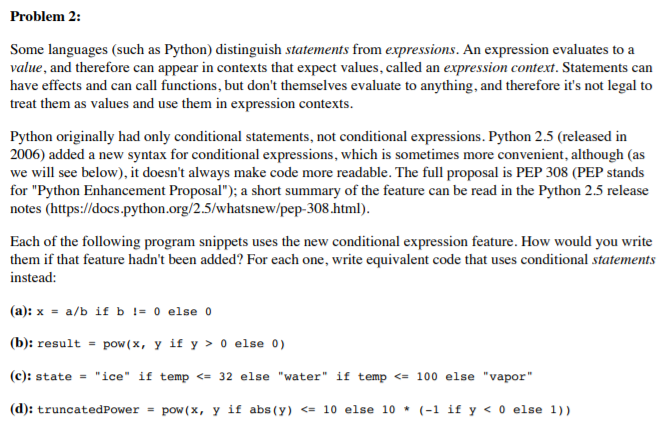
Problem 2: Some languages (such as Python) distinguish statements from expressions. An expression evaluates to a value, and therefore can appear in contexts that expect values, called an expression context. Statements can have effects and can call functions, but don't themselves evaluate to anything, and therefore it's not legal to treat them as values and use them in expression contexts. Python originally had only conditional statements, not conditional expressions. Python 2.5 (released in 2006) added a new syntax for conditional expressions, which is sometimes more convenient, although (as we will see below), it doesn't always make code more readable. The full proposal is PEP 308 (PEP stands for "Python Enhancement Proposal"); a short summary of the feature can be read in the Python 2.5 release notes (https://docs.python.org/2.5/whatsnew/pep-308.html). Each of the following program snippets uses the new conditional expression feature. How would you write them if that feature hadn't been added? For each one, write equivalent code that uses conditional statements instead: (a): x = a/b if b != 0 else 0 (b): result = pow(x, y if y > o else 0) (c): state = "ice" if temp
Step by Step Solution
There are 3 Steps involved in it

Get step-by-step solutions from verified subject matter experts
 Study Help