







Question: Problem 2: Suppose G is a connected, undirected graph. A cut node (also called a separating vertex) is a node whose removal disconnects the graph.
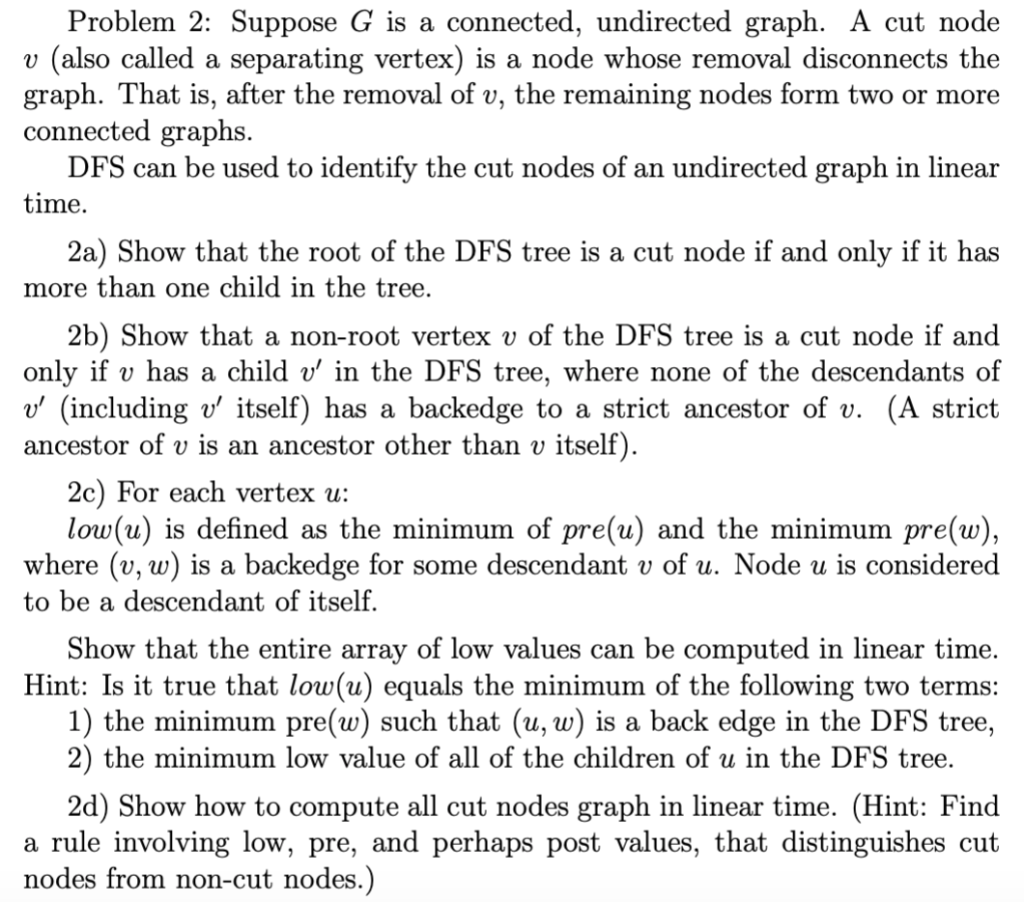
Problem 2: Suppose G is a connected, undirected graph. A cut node (also called a separating vertex) is a node whose removal disconnects the graph. That is, after the removal of v, the remaining nodes form two or more connected graphs DFS can be used to identify the cut nodes of an undirected graph in linear time. 2a) Show that the root of the DFS tree is a cut node if and only if it has more than one child in the tree. 2b) Show that a non-root vertex v of the DFS tree is a cut node if and only if v has a child v' in the DFS tree, where none of the descendants of v' (including v' itself) has a backedge to a strict ancestor of v. (A strict ancestor of v is an ancestor other than v itself) 2c) For each vertex u: low(u) is defined as the minimum of pre(u) and the minimum pre(w) where (v, w) is a backedge for some descendant v of u. Node u is considered to be a descendant of itself. Show that the entire array of low values can be computed in linear time. Hint: Is it true that low(u) equals the minimum of the following two terms: 1) the minimum pre(w) such that (u, w) is a back edge in the DFS tree, 2) the minimum low value of all of the children of u in the DFS tree. 2d) Show how to compute all cut nodes graph in linear time. (Hint: Find a rule involving low, pre, and perhaps post values, that distinguishes cut nodes from non-cut nodes. Problem 2: Suppose G is a connected, undirected graph. A cut node (also called a separating vertex) is a node whose removal disconnects the graph. That is, after the removal of v, the remaining nodes form two or more connected graphs DFS can be used to identify the cut nodes of an undirected graph in linear time. 2a) Show that the root of the DFS tree is a cut node if and only if it has more than one child in the tree. 2b) Show that a non-root vertex v of the DFS tree is a cut node if and only if v has a child v' in the DFS tree, where none of the descendants of v' (including v' itself) has a backedge to a strict ancestor of v. (A strict ancestor of v is an ancestor other than v itself) 2c) For each vertex u: low(u) is defined as the minimum of pre(u) and the minimum pre(w) where (v, w) is a backedge for some descendant v of u. Node u is considered to be a descendant of itself. Show that the entire array of low values can be computed in linear time. Hint: Is it true that low(u) equals the minimum of the following two terms: 1) the minimum pre(w) such that (u, w) is a back edge in the DFS tree, 2) the minimum low value of all of the children of u in the DFS tree. 2d) Show how to compute all cut nodes graph in linear time. (Hint: Find a rule involving low, pre, and perhaps post values, that distinguishes cut nodes from non-cut nodes
Step by Step Solution
There are 3 Steps involved in it

Get step-by-step solutions from verified subject matter experts
 Study Help