







Question: Problem 2. Suppose we select 4 students from the class to play the following game: . I give each student one (infinitely divisible) dollar. Each
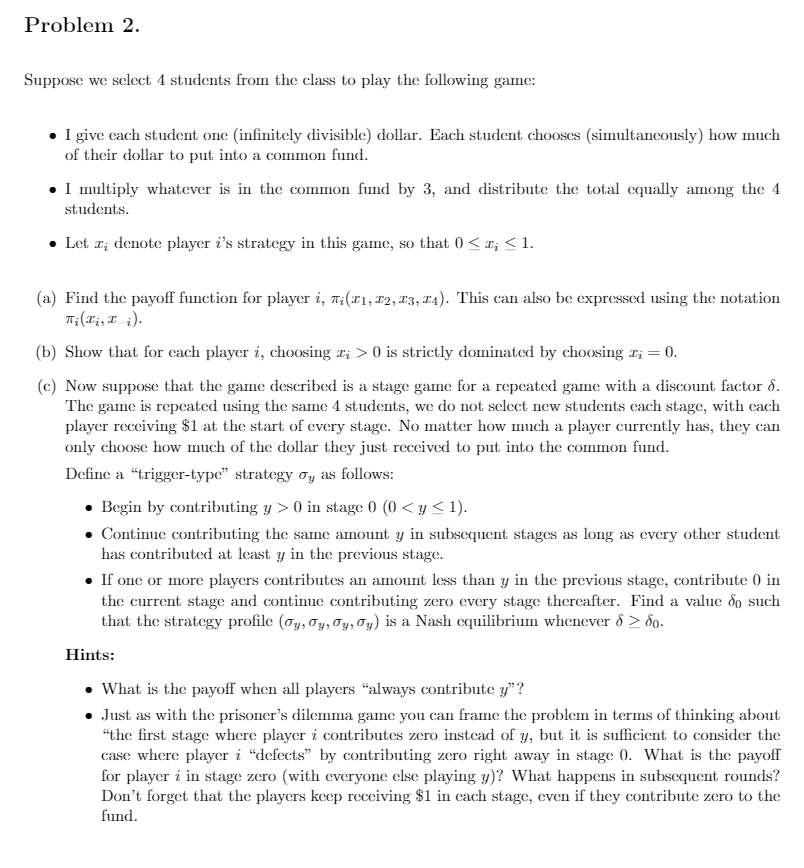
Problem 2. Suppose we select 4 students from the class to play the following game: . I give each student one (infinitely divisible) dollar. Each student chooses (simultaneously) how much of their dollar to put into a common fund. . I multiply whatever is in the common fund by 3, and distribute the total equally among the 4 students. . Let ; denote player i's strategy in this game, so that 0 0 is strictly dominated by choosing ri = 0. (c) Now suppose that the game described is a stage game for a repeated game with a discount factor 6. The game is repeated using the same 4 students, we do not select new students each stage, with each player receiving $1 at the start of every stage. No matter how much a player currently has, they can only choose how much of the dollar they just received to put into the common fund. Define a "trigger-type" strategy Gy as follows: . Begin by contributing y > 0 in stage 0 (0 do. Hints: . What is the payoff when all players "always contribute y"? . Just as with the prisoner's dilemma game you can frame the problem in terms of thinking about "the first stage where player i contributes zero instead of y, but it is sufficient to consider the case where player i "defects" by contributing zero right away in stage 0. What is the payoff for player i in stage zero (with everyone else playing y)? What happens in subsequent rounds? Don't forget that the players keep receiving $1 in each stage, even if they contribute zero to the fund
Step by Step Solution
There are 3 Steps involved in it

Get step-by-step solutions from verified subject matter experts
 Study Help