Question: PROBLEM 2. The Millennium Development Corporation has just received a small hotel for conversion to condominium apartments. The building, in a popular area of Washington,
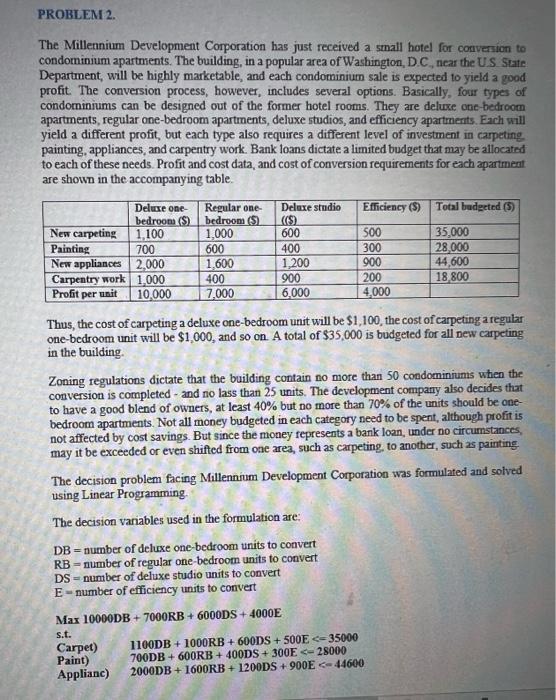
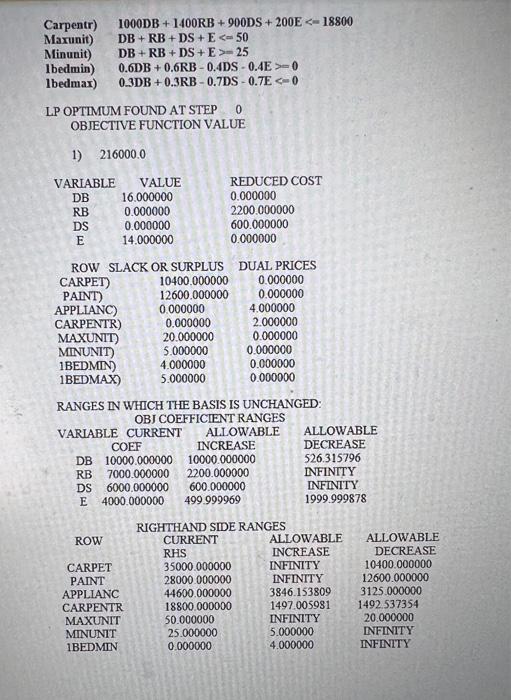
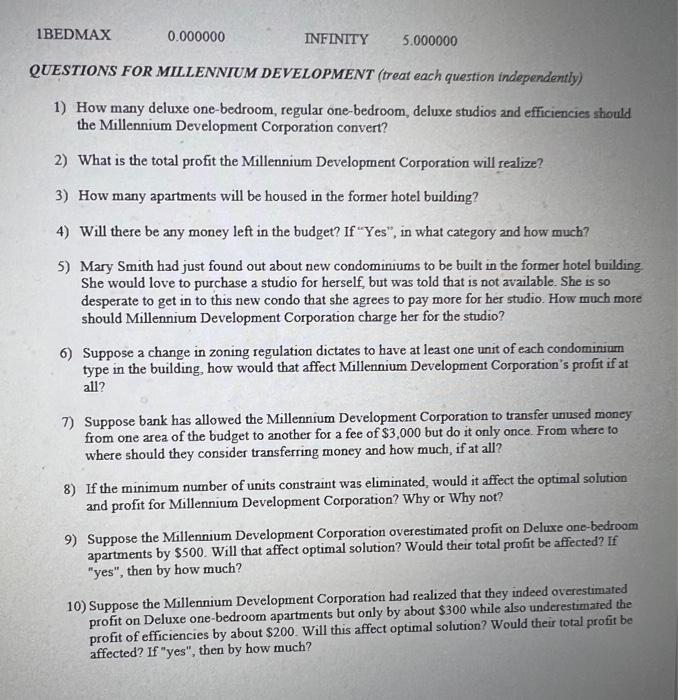
PROBLEM 2. The Millennium Development Corporation has just received a small hotel for conversion to condominium apartments. The building, in a popular area of Washington, DC, near the US State Department, will be highly marketable, and each condominium sale is expected to yield a good profit. The conversion process, however, includes several options. Basically, four types of condominiums can be designed out of the former hotel rooms. They are deluxe one bedroom apartments, regular one-bedroom apartments, deluxe studios, and efficiency apartments. Each will yield a different profit, but each type also requires a different level of investment in carpeting painting, appliances, and carpentry work. Bank loans dictate a limited budget that may be allocated to each of these needs. Profit and cost data and cost of conversion requirements for each apartment are shown in the accompanying table. Deluxe one Regular one Deluxe studio Efficiency (5) Total budgeted (5) bedroom (5) bedroom (5) ((S) New carpeting 1,100 1.000 600 500 35,000 Painting 700 600 400 300 28,000 New appliances 2,000 1.600 1,200 900 44,600 Carpentry work 1,000 400 900 200 18.800 Profit per unit 10.000 7,000 6.000 4,000 Thus, the cost of carpeting a deluxe one bedroom unit will be $1,100, the cost of carpeting a regular one-bedroom unit will be $1,000, and so on A total of $35,000 is budgeted for all new carpeting in the building Zoning regulations dictate that the building contain no more than 50 condominiums when the conversion is completed - and no lass than 25 units. The development company also decides that to have a good blend of owners, at least 40% but no more than 70% of the units should be one bedroom apartments. Not all money budgeted in each category need to be spent, although profit is not affected by cost savings. But since the money represents a bank loan, under no circumstances, may it be exceeded or even shifted from one area, such as carpeting, to another, such as painting The decision problem facing Millennium Development Corporation was formulated and solved using Linear Programming The decision variables used in the formulation are: DB = number of deluxe one-bedroom units to convert RB-number of regular one-bedroom units to convert DS - number of deluxe studio units to convert E-number of efficiency units to convert Max 10000DB +7000RB + 6000DS + 4000E s.t. Carpet) 1100DB + 1000RB + 600DS + 500E =35000 Paint) 700DB + 600RB + 400DS + 300E - 28000 Applianc) 2000DB + 1600RB + 1200DS + 900E 44600 Carpentr) 1000DB + 1400RB + 900DS+200E - 25 Ibedmin) 0.6DB +0.6RB -0.4DS -0.4E > 0 lbedmar) 0.3DB+0.3RB -0.7DS - 0.7E-0 LP OPTIMUM FOUND AT STEP 0 OBJECTIVE FUNCTION VALUE 1) 216000.0 VARIABLE VALUE REDUCED COST DB 16.000000 0.000000 RB 0.000000 2200.000000 DS 0.000000 600.000000 E 14.000000 0.000000 ROW SLACK OR SURPLUS DUAL PRICES CARPET) 10400.000000 0.000000 PAINT) 12600.000000 0.000000 APPLIANC) 0.000000 4.000000 CARPENTR) 0.000000 2.000000 MAXUNIT) 20.000000 0.000000 MINUNIT) 5.000000 0.000000 1BEDMIN) 4.000000 0.000000 1BEDMAX) 5.000000 0.000000 RANGES IN WHICH THE BASIS IS UNCHANGED: OBJ COEFFICIENT RANGES VARIABLE CURRENT ALLOWABLE ALLOWABLE COEF INCREASE DECREASE DB 10000.000000 10000.000000 526.315796 RB 7000.000000 2200.000000 INFINITY DS 6000.000000 600.000000 INFINITY E 4000.000000 499 999969 1999.999878 ROW CARPET PAINT APPLIANC CARPENTR MAXUNIT MINUNIT 1BEDMIN RIGHTHAND SIDE RANGES CURRENT ALLOWABLE RHS INCREASE 35000.000000 INFINITY 28000.000000 INFINITY 44600.000000 3846.153809 18800.000000 1497.005981 50.000000 INFINITY 25.000000 5.000000 0.000000 4.000000 ALLOWABLE DECREASE 10400.000000 12600.000000 3125.000000 1492.537354 20.000000 INFINITY INFINITY 1BEDMAX 0.000000 INFINITY 5.000000 QUESTIONS FOR MILLENNIUM DEVELOPMENT (treat each question independently) 1) How many deluxe one-bedroom, regular one-bedroom, deluxe studios and efficiencies should the Millennium Development Corporation convert? 2) What is the total profit the Millennium Development Corporation will realize? 3) How many apartments will be housed in the former hotel building? 4) Will there be any money left in the budget? If"Yes", in what category and how much? 5) Mary Smith had just found out about new condominiums to be built in the former hotel building She would love to purchase a studio for herself, but was told that is not available. She is so desperate to get in to this new condo that she agrees to pay more for her studio. How much more should Millennium Development Corporation charge her for the studio? 6) Suppose a change in zoning regulation dictates to have at least one unit of each condominium type in the building, how would that affect Millennium Development Corporation's profit if at all? 7) Suppose bank has allowed the Millennium Development Corporation to transfer unused money from one area of the budget to another for a fee of $3,000 but do it only once. From where to where should they consider transferring money and how much, if at all? 8) If the minimum number of units constraint was eliminated, would it affect the optimal solution and profit for Millennium Development Corporation? Why or Why not? 9) Suppose the Millennium Development Corporation overestimated profit on Deluxe one-bedroom apartments by $500. Will that affect optimal solution? Would their total profit be affected? If "yes", then by how much? 10) Suppose the Millennium Development Corporation had realized that they indeed overestimated profit on Deluxe one-bedroom apartments but only by about $300 while also underestimated the profit of efficiencies by about $200. Will this affect optimal solution? Would their total profit be affected? If "yes", then by how much









 Study Help