





Question: Problem 2 (The Perron-Frobenius theorem). Let A e M, (R). We say A = [ajj] is non- negative and write A 2 0 if a;;
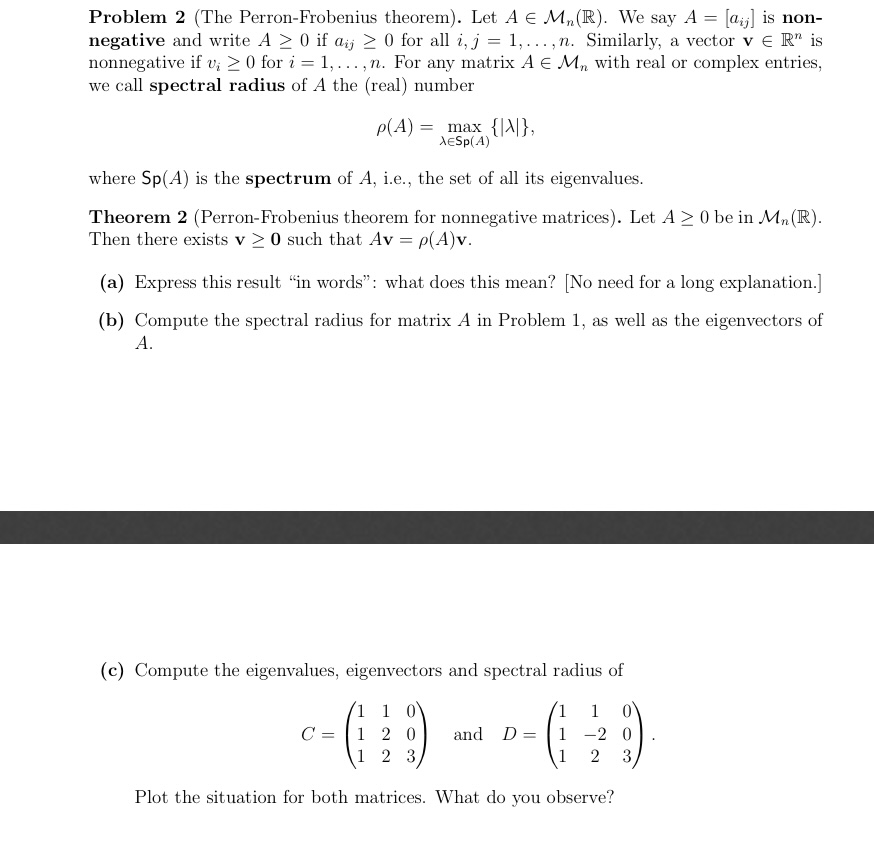
Problem 2 (The Perron-Frobenius theorem). Let A e
Problem 2 (The Perron-Frobenius theorem). Let A e M, (R). We say A = [ajj] is non- negative and write A 2 0 if a;; 2 0 for all i, j = 1, ...,n. Similarly, a vector ve R" is nonnegative if v; 2 0 for i = 1, . .., n. For any matrix A E M, with real or complex entries, we call spectral radius of A the (real) number p(A) = max {IA}, XESp(A) where Sp(A) is the spectrum of A, i.e., the set of all its eigenvalues. Theorem 2 (Perron-Frobenius theorem for nonnegative matrices). Let A 2 0 be in M, (R). Then there exists v 2 0 such that Av = p(A)v. (a) Express this result "in words": what does this mean? [No need for a long explanation.] (b) Compute the spectral radius for matrix A in Problem 1, as well as the eigenvectors of A. (c) Compute the eigenvalues, eigenvectors and spectral radius of C- (13 9 ) and D= (: 1 0 2 3 Plot the situation for both matrices. What do you observe

Step by Step Solution

There are 3 Steps involved in it

1 Expert Approved Answer
Step: 1 Unlock blur-text-image
Question Has Been Solved by an Expert!

Get step-by-step solutions from verified subject matter experts

Step: 2 Unlock
Step: 3 Unlock

Students Have Also Explored These Related Mathematics Questions!