







Question: Problem 2. The tree for Heap Sort is normally stored in an array left-to-right, top-to-bottom. So the root is in A[1], the left child of
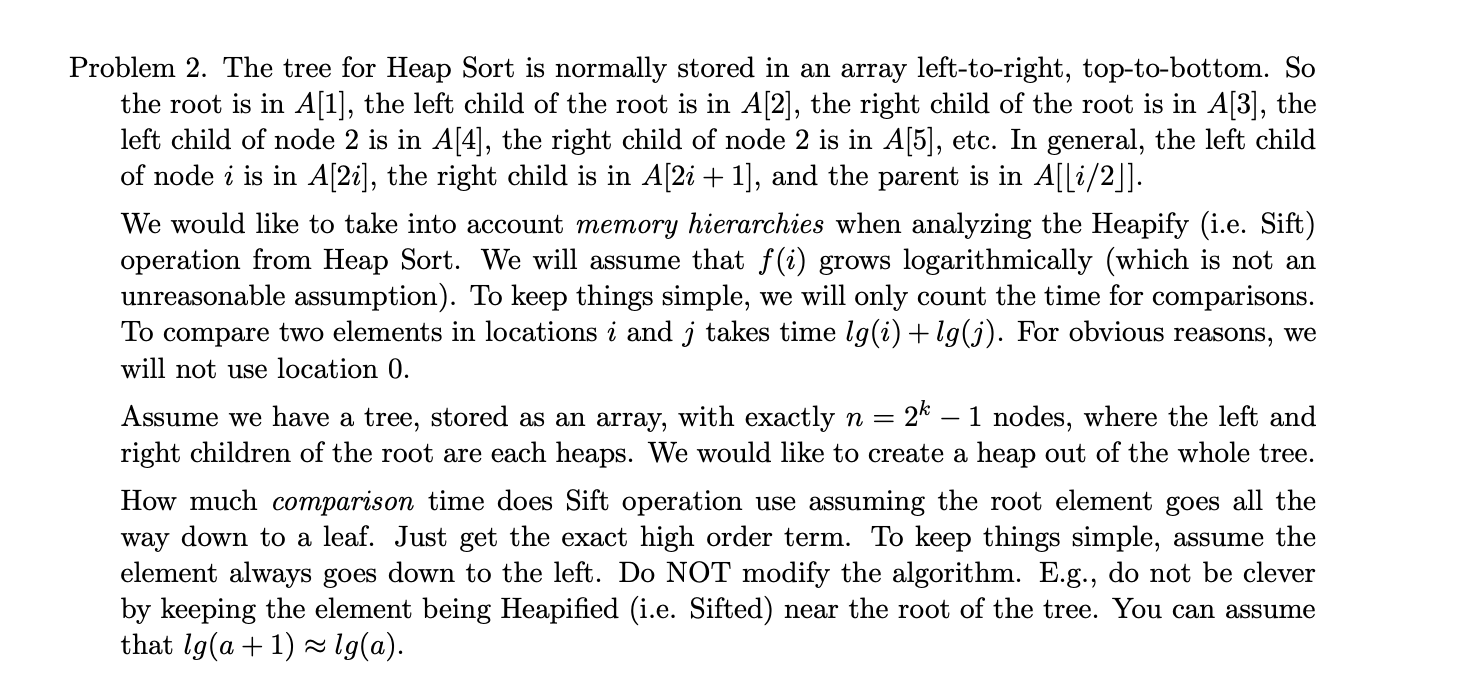
Problem 2. The tree for Heap Sort is normally stored in an array left-to-right, top-to-bottom. So the root is in A[1], the left child of the root is in A[2], the right child of the root is in A[3], the left child of node 2 is in A[4], the right child of node 2 is in A[5], etc. In general, the left child of node i is in A[2i], the right child is in A[2i +1], and the parent is in A[[i/2]]. We would like to take into account memory hierarchies when analyzing the Heapify (i.e. Sift) operation from Heap Sort. We will assume that f(i) grows logarithmically (which is not an unreasonable assumption). To keep things simple, we will only count the time for comparisons. To compare two elements in locations i and j takes time lg(i) + 1g(j). For obvious reasons, we will not use location 0. Assume we have a tree, stored as an array, with exactly n = - 2k - 1 nodes, where the left and right children of the root are each heaps. We would like to create a heap out of the whole tree. How much comparison time does Sift operation use assuming the root element goes all the way down to a leaf. Just get the exact high order term. To keep things simple, assume the element always goes down to the left. Do NOT modify the algorithm. E.g., do not be clever by keeping the element being Heapified (i.e. Sifted) near the root of the tree. You can assume that lg(a + 1) =lg(a)
Step by Step Solution
There are 3 Steps involved in it

Get step-by-step solutions from verified subject matter experts
 Study Help