Question: Problem 2. This problem concerns with: Given a matrix A , when is A A invertible? The answer is simple and we will discover it
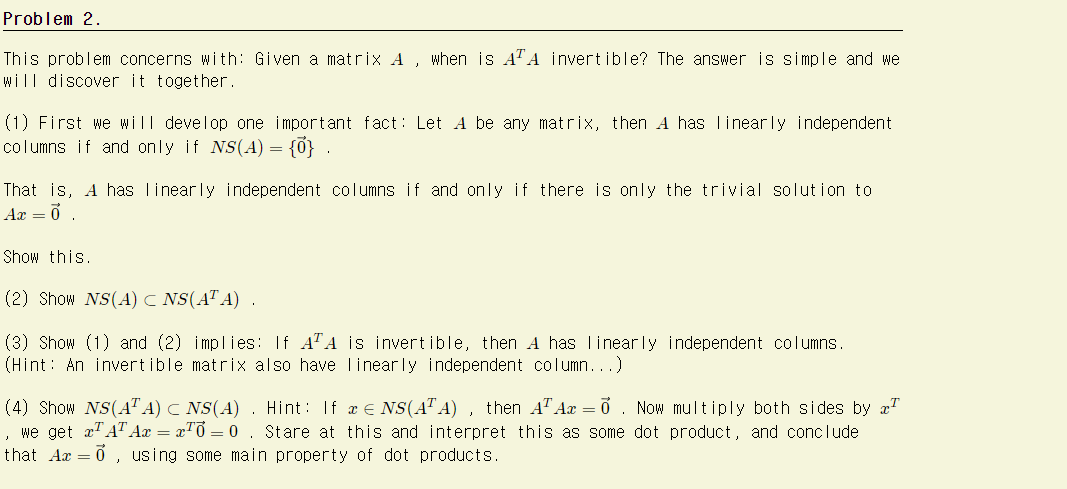
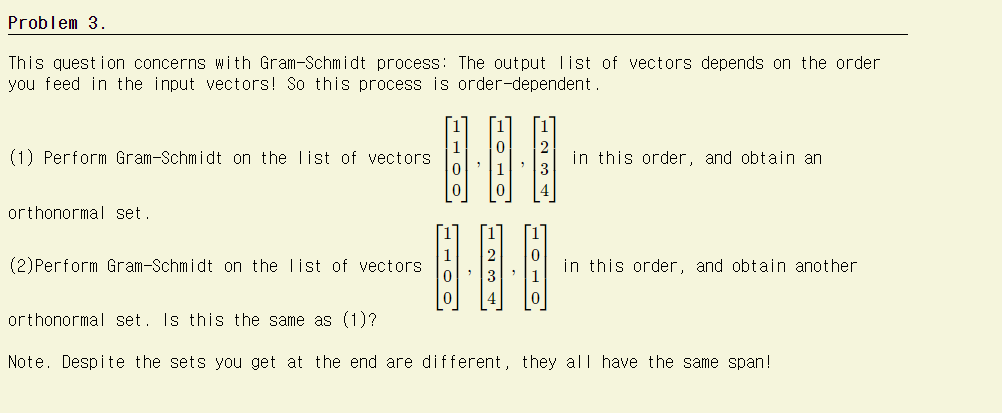
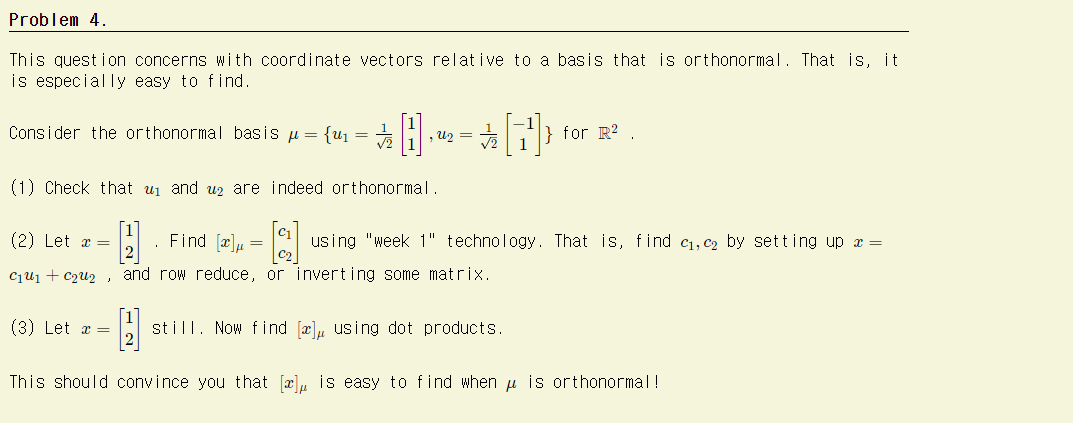
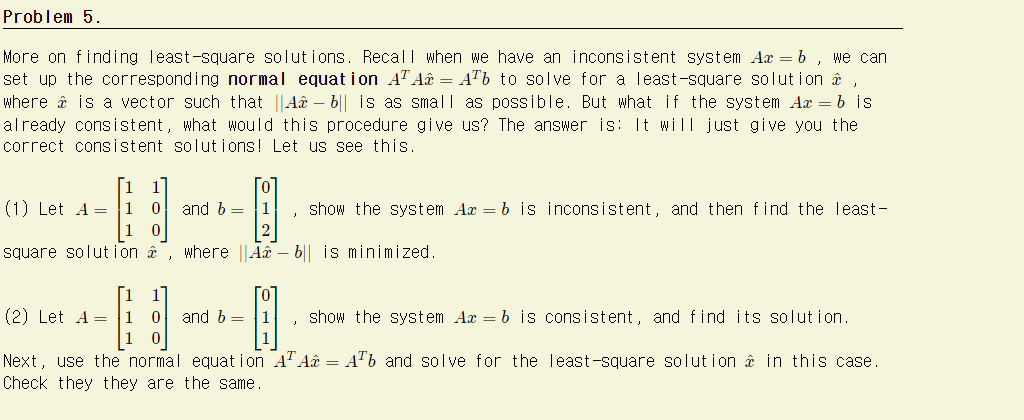
Problem 2. This problem concerns with: Given a matrix A , when is A A invertible? The answer is simple and we will discover it together . (1) First we will develop one important fact : Let A be any matrix, then A has linearly independent columns if and only if NS(A) = {0} . That is, A has linearly independent columns if and only if there is only the trivial solution to Ax = 0 Show this. (2) Show NS(A) C NS(ATA) . (3) Show (1) and (2) implies: If ATA is invertible, then A has linearly independent columns. (Hint : An invertible matrix also have linearly independent column...) (4) Show NS(ATA) CNS(A) . Hint : If ENS(ATA) , then A"Ax = 0 . Now multiply both sides by a , we get x A Ax = x 0 =0 . Stare at this and interpret this as some dot product, and conclude that Ax =0 , using some main property of dot products.(5) Using (1) and (4) to conclude: if A has linearly independent columns; then ATA is invertible. There we go! We showed this (important) fact: For any matrix A J ATA is invertible if and only if A has linearly independent columns. Problem 3. This question concerns with Gram-Schmidt process: The output list of vectors depends on the order you feed in the input vectors! So this process is orderdependent. (1) Perform GramSchmidt on the list of vectors in this order; and obtain an calAH QHmiu gamutn orthonormal set. (EJPerform GramSchmidt on the list of vectors in this order; and obtain another '1 1 1 U c: :3 ha he FP-WMlt orthonormal set. is this the same as (1)? Note. Despite the sets you get at the end are differentJ they all have the same span! Problem 4. This question concerns with coordinate vectors relative to a basis that is orthonormal. That is. it is especially easy to find. Consider the orthonormal basis ,u.={u1 = i [1] mg: i [31]} for R2 . (1] Check that m and H2 are indeed orthonormal. (2) Let 3:: [g] . Find [mLI==l:'] using \"week 1\" technology. That is. find c1,c2 by setting up m:= 2 c1u1+cgu2 , and row reduce, or inverting some matrix. (8] Let 3: E] still. Now find [37]}: using dot products. This should convince you that [3]\" is easy to find when p. is orthonormal! Problem 5. More on finding leastsquare solutions. Recall when we have an inconsistent system 143 ==b , we can set up the corresponding normal equation A?l4i==.ATb to solve for a leastsquare solution i , where i is a vector such that H;LibH is as small as possible. But what if the system 143 ==b is already consistent, what would this procedure give us? The answer is: it will just give you the correct consistent solutions! Let us see this. 1 1 o (i) Let.A = 1 0 and 5:: 1 , show the system Am ==b is inconsistent, and then find the least 1 0 2 square solution , where H;hibH is minimized. 1 1 0 (2) Let.A== 1 0 and 5:: 1 , show the system Am ==b is consistent, and find its solution. 1 o 1 Next, use the normal eguation.A1X4i==_A?b and solve for the leastsquare solution i in this case. Check they they are the same
Step by Step Solution
There are 3 Steps involved in it
1 Expert Approved Answer
Step: 1 Unlock
Question Has Been Solved by an Expert!
Get step-by-step solutions from verified subject matter experts
Step: 2 Unlock
Step: 3 Unlock
Students Have Also Explored These Related Mathematics Questions!










 Study Help