Question: PROBLEM 2 This question has 2 parts. Part 1: The drawing below shows a Hasse diagram for a partial order on the set: [A, B,
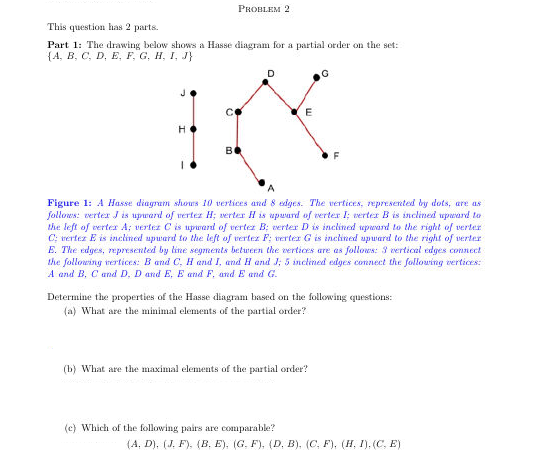
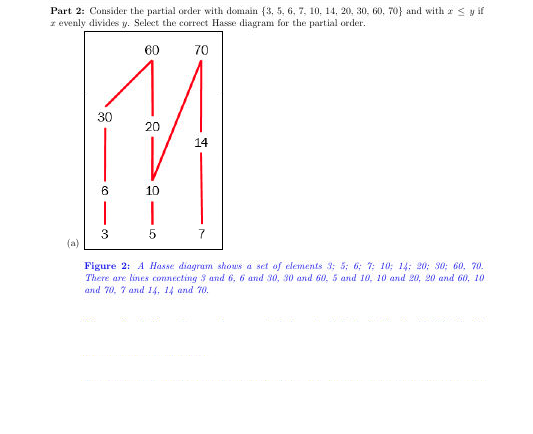
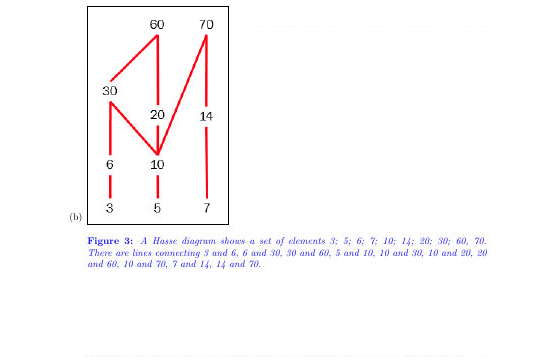
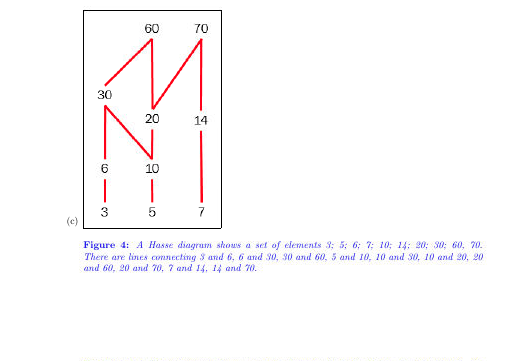
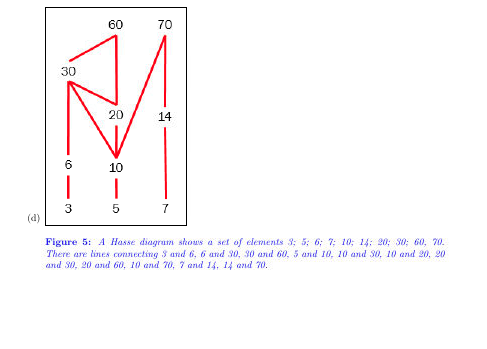
PROBLEM 2 This question has 2 parts. Part 1: The drawing below shows a Hasse diagram for a partial order on the set: [A, B, C. D. E, F. G. H, I, J} D G C F H Figure 1: A Hasse diagram shows 10 vertices and 8 edges. The vertices, represented by dots, are as follows: verter J is upward of vertez H; verter H is upward of verter I; verter B is inclined upward to the left of verter A; verter C is upward of vertes B; verter Dis inclined upward to the right of vertex C. werfer E is inclined upward to the left of vertex F; verter G is inclined upward to the right of verter E. The edges, represented by line segments between the vertices are as follows: 3 vertical edges connect the following vertices: B and C. H and I, and H and J, 5 inclined edges connect the following vertices: A and B. C and D. D and E. E and F. and E and G. Determine the properties of the Hasse diagram based on the following questions: (a) What are the minimal elements of the partial order? (b) What are the maximal elements of the partial order? (c) Which of the following pairs are comparable? (A. D). (J. F), (B. E), (G. F), (D. B) (C. F), (H. D). (C, E)Part 2: Consider the partial order with domain {3, 5, 6, 7, 10. 14, 20, 30. 60. 70} and with a s y if x evenly divides p. Select the correct Hasse diagram for the partial order. 60 70 30 20 14 10 3 5 7 (a) Figure 2: A Hasse diagram shows a set of elements 3: 5; 6; 7: 10; 14: 20; 30; 60, 70. There are lines connecting 3 and 6. 5 and 30, 30 and 60, 5 and 10, 10 and 20, 20 and 60, 10 and 70. 7 and 14, 14 and 70.60 70 14 10 3 5 7 (b) Figure 3: A Hasse diagram shows a set of elements 3: 5; 6; 7; 10; 14; 20; 30; 60, 70. There are lines connecting 3 and 6. 6 and 30. 30 and 60. 5 and 10. 10 and 30, 10 and 20, 20 and 60. 10 and 70, 7 and 14, 14 and 70.60 70 30 20 14 6 3 (c) Figure 4: A Hasse diagram shows a set of elements 3: 5; 6; 7; 10; 14; 20; 30; 60, 70. There are lines connecting 3 and 6. 6 and 30, 30 and 60. 5 and 10, 10 and 30, 10 and 20, 20 and 60, 20 and 70, 7 and 14, 14 and 70.60 70 30 20 14 6 10 5 7 (d) Figure 5: A Hasse diagram shows a set of elements 3: 5; 6; 7; 10; 14; 20; 30; 60, 70. There are lines connecting 3 and 6. 6 and 30, 30 and 60. 5 and 10, 10 and 30, 10 and 20, 20 and 30, 20 and 60, 10 and 70, 7 and 14, 14 and 70
Step by Step Solution
There are 3 Steps involved in it
1 Expert Approved Answer
Step: 1 Unlock
Question Has Been Solved by an Expert!
Get step-by-step solutions from verified subject matter experts
Step: 2 Unlock
Step: 3 Unlock
Students Have Also Explored These Related Mathematics Questions!









 Study Help