







Question: Problem 2 Under the same setting as Problem 1, suppose that D,- is assigned to the n units in a Bernoulli trial, that is each
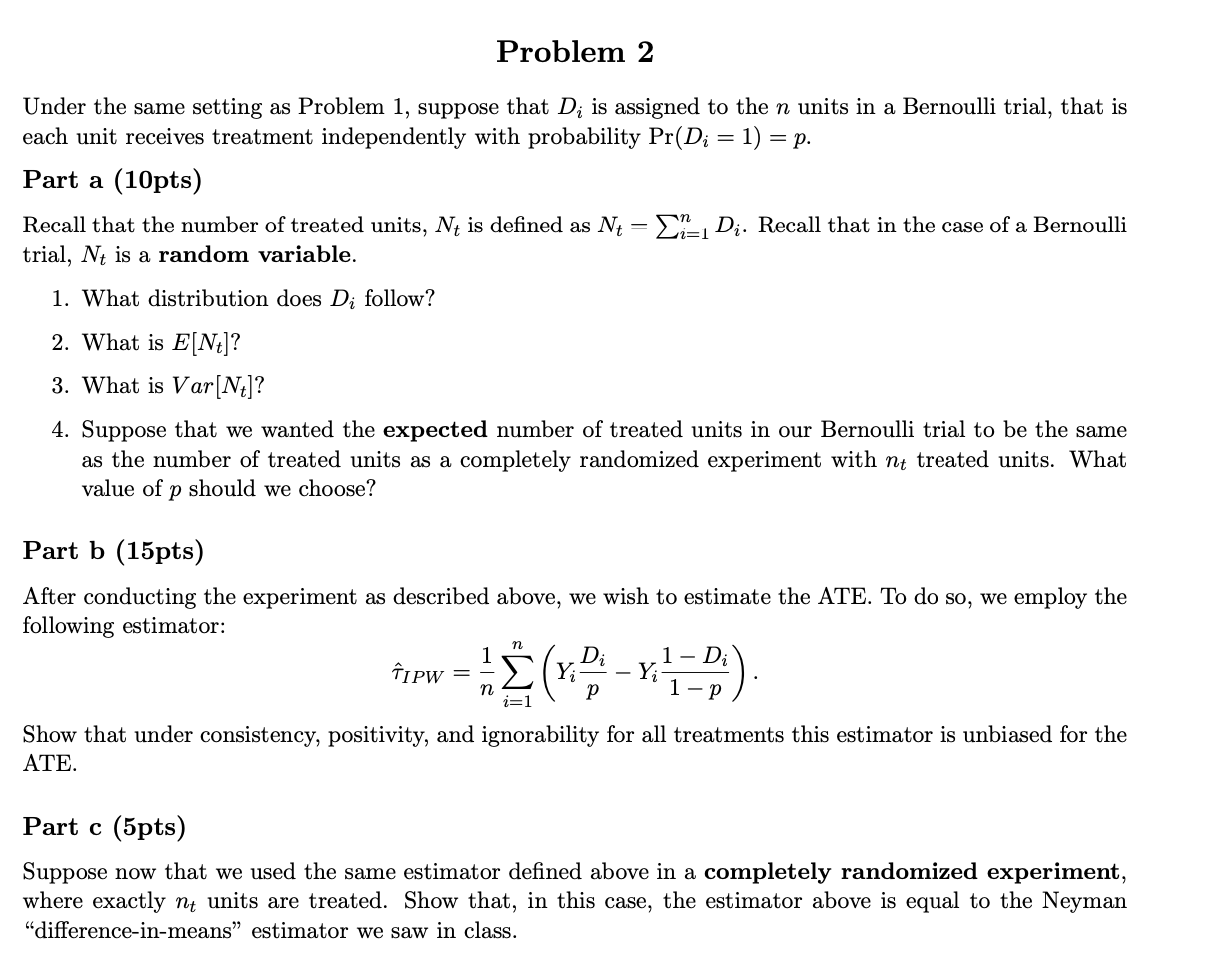
Problem 2 Under the same setting as Problem 1, suppose that D,- is assigned to the n units in a Bernoulli trial, that is each unit receive-2. treatment independently with probability Pr(D,- = 1) = p. Part a (lOpts) Recall that the number of treated units, N; is dened as N, = :1: l 1),. Recall that in the case of a Bernoulli trial, N; is a random variable. 1. What distribution does D, follow? 2. What is E[Nt]? 3. What is Vor[Nt]? 4 . Suppose that we wanted the expected number of treated units in our Bernoulli trial to be the same as the number of treated units as a completely randomized experiment with m treated units. What value of 30 should we choose? Part b (l5pts) After conducting the experiment as described above, we wish to estimate the ATE. To do so, we employ the following estimator: n A 1 D, 1D,- TIPW-gZ(KY ) 1. ,=, p 110 Show that under consistency, positivity, and ignorability for all treatments this estimator is unbiased for the ATE. Part c (5pts) Suppose now that we used the same estimator dened above in a completely randomized experiment, where exactly at units are treated. Show that, in this case, the estimator above is equal to the Neyman \"differenceinmeans\" estimator we saw in class
Step by Step Solution
There are 3 Steps involved in it

Get step-by-step solutions from verified subject matter experts
 Study Help