







Question: PROBLEM 2: VERTEX COVER Consider the following language from the text, VERTEXCOVER G, k) G is an undirected graph that has a k-node vertex cover]
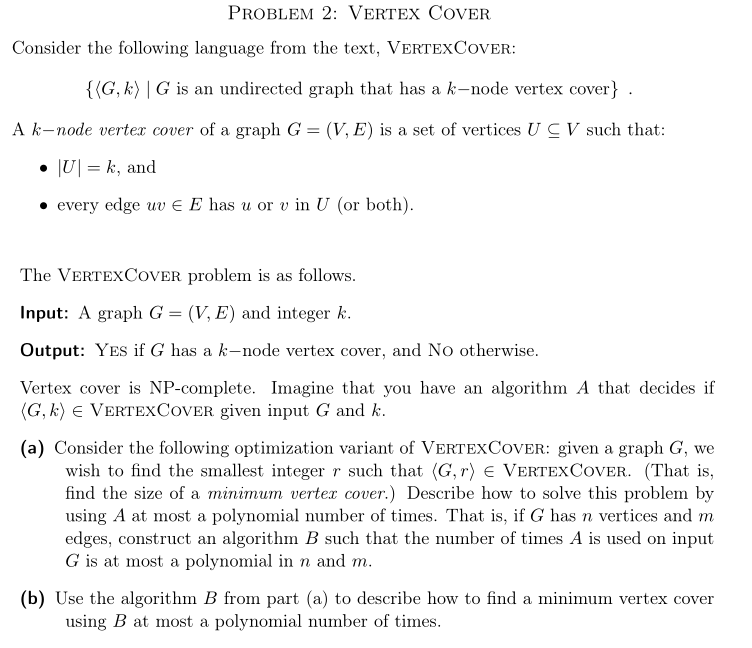
PROBLEM 2: VERTEX COVER Consider the following language from the text, VERTEXCOVER G, k) G is an undirected graph that has a k-node vertex cover] A k-node verter cover of a graph G- (V, E) is a set of vertices U CV such that: IUI = k, and . every edge uv E E has u or v in U (or both) The VERTEXCOVER problem is as follows. Input: A graph G = (V, E) and integer k. Output: YEs if G has a k-node vertex cover, and No otherwise. Vertex cover is NP-complete. Imagine that you have an algorithm A that decides if G, k E VERTEXCOVER given input G and k (a) Consider the following optimization variant of VERTEXCOVER: given a graph G, we wish to find the smallest integer r such that G,r) VERTEXCOVER. (That is, find the size of a minimum verter cover.) Describe how to solve this problem by using A at most a polynomial number of times. That is, if G has n vertices and m edges, construct an algorithm B such that the number of times A is used on input G is at most a polynomial in n and m. (b) Use the algorithm B from part (a) to describe how to find a minimum vertex cover using B at most a polynomial number of times
Step by Step Solution
There are 3 Steps involved in it

Get step-by-step solutions from verified subject matter experts
 Study Help