







Question: Problem 20-23 (LO. 1, 4) Dove Corporation (E & P of $800,000) has 1,000 shares of stock outstanding. The shares are owned as follows: Julia,
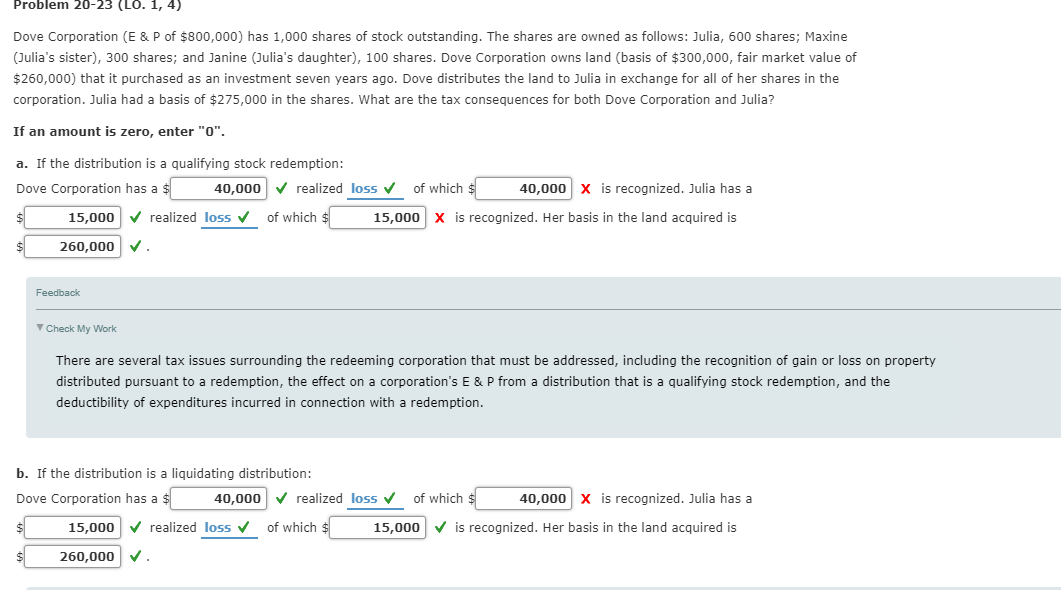
Problem 20-23 (LO. 1, 4) Dove Corporation (E & P of $800,000) has 1,000 shares of stock outstanding. The shares are owned as follows: Julia, 600 shares; Maxine (Julia's sister), 300 shares; and Janine (Julia's daughter), 100 shares. Dove Corporation owns land (basis of $300,000, fair market value of $260,000) that it purchased as an investment seven years ago. Dove distributes the land to Julia in exchange for all of her shares in the corporation. Julia had a basis of $275,000 in the shares. What are the tax consequences for both Dove Corporation and Julia? If an amount is zero, enter "0". a. If the distribution is a qualifying stock redemption: Dove Corporation has a $ 40,000 realized loss of which $ 40,000 X is recognized. Julia has a $ 15,000 realized loss of which $ 15,000 X is recognized. Her basis in the land acquired is $ 260,000 . Feedback Check My Work There are several tax issues surrounding the redeeming corporation that must be addressed, including the recognition of gain or loss on property distributed pursuant to a redemption, the effect on a corporation's E&P from a distribution that is a qualifying stock redemption, and the deductibility of expenditures incurred in connection with a redemption. b. If the distribution is a liquidating distribution: Dove Corporation has a $ 40,000 realized loss of which $ 40,000 X is recognized. Julia has a $ 15,000 realized loss of which $ 15,000 is recognized. Her basis in the land acquired is $ 260,000 V. Problem 20-23 (LO. 1, 4) Dove Corporation (E & P of $800,000) has 1,000 shares of stock outstanding. The shares are owned as follows: Julia, 600 shares; Maxine (Julia's sister), 300 shares; and Janine (Julia's daughter), 100 shares. Dove Corporation owns land (basis of $300,000, fair market value of $260,000) that it purchased as an investment seven years ago. Dove distributes the land to Julia in exchange for all of her shares in the corporation. Julia had a basis of $275,000 in the shares. What are the tax consequences for both Dove Corporation and Julia? If an amount is zero, enter "0". a. If the distribution is a qualifying stock redemption: Dove Corporation has a $ 40,000 realized loss of which $ 40,000 X is recognized. Julia has a $ 15,000 realized loss of which $ 15,000 X is recognized. Her basis in the land acquired is $ 260,000 . Feedback Check My Work There are several tax issues surrounding the redeeming corporation that must be addressed, including the recognition of gain or loss on property distributed pursuant to a redemption, the effect on a corporation's E&P from a distribution that is a qualifying stock redemption, and the deductibility of expenditures incurred in connection with a redemption. b. If the distribution is a liquidating distribution: Dove Corporation has a $ 40,000 realized loss of which $ 40,000 X is recognized. Julia has a $ 15,000 realized loss of which $ 15,000 is recognized. Her basis in the land acquired is $ 260,000 V
Step by Step Solution
There are 3 Steps involved in it

Get step-by-step solutions from verified subject matter experts
 Study Help