







Question: Problem 21. A normal random variable X is known to have a mean of 60 and a standard deviation equal to 5 (hypothesis Ho) or
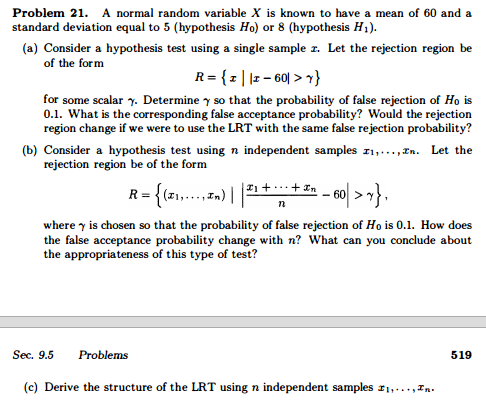
Problem 21. A normal random variable X is known to have a mean of 60 and a standard deviation equal to 5 (hypothesis Ho) or 8 (hypothesis H1). (a) Consider a hypothesis test using a single sample r. Let the rejection region be of the form R= {I | |I -60) > } for some scalar y. Determine y so that the probability of false rejection of Ho is 0.1. What is the corresponding false acceptance probability? Would the rejection region change if we were to use the LRT with the same false rejection probability? (b) Consider a hypothesis test using n independent samples 11, ..., In. Let the rejection region be of the form R = (21,..., In) |+ +In -60 >471 n where y is chosen so that the probability of false rejection of Ho is 0.1. How does the false acceptance probability change with n? What can you conclude about the appropriateness of this type of test? Sec. 9.5 Problems 519 (c) Derive the structure of the LRT using n independent samples $1, . .., In
Step by Step Solution
There are 3 Steps involved in it

Get step-by-step solutions from verified subject matter experts
 Study Help