





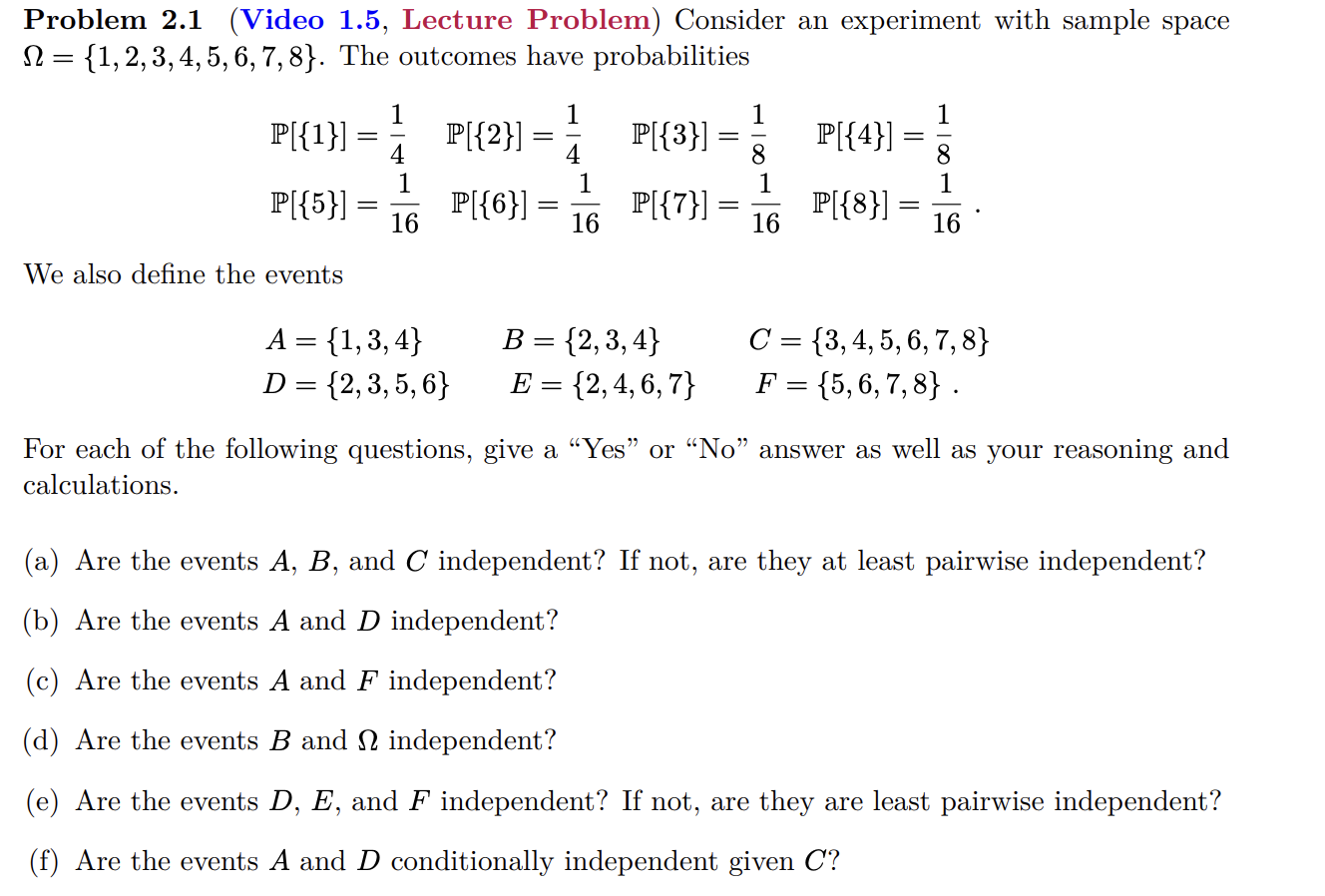
Question: Problem 2.1 (Video 1.5, Lecture Problem) Consider an experiment with sample space n = {1, 2, 3, 4, 5, 6, 7, 8}. The outcomes have
Problem 2.1 (Video 1.5, Lecture Problem) Consider
Problem 2.1 (Video 1.5, Lecture Problem) Consider an experiment with sample space n = {1, 2, 3, 4, 5, 6, 7, 8}. The outcomes have probabilities PH1}] = PH3}] PR4} = - OOH P(5}1 = 16 P[{6}] 16 PH7} = 16 PH8}] = 16 We also define the events A = {1, 3, 4} B = {2, 3,4} C = {3, 4, 5, 6, 7,8} D = {2, 3, 5, 6} E = {2, 4, 6, 7} F = {5, 6, 7, 8} . For each of the following questions, give a "Yes" or "No" answer as well as your reasoning and calculations. (a) Are the events A, B, and C independent? If not, are they at least pairwise independent? (b) Are the events A and D independent? (c) Are the events A and F independent? (d) Are the events B and & independent? (e) Are the events D, E, and F independent? If not, are they are least pairwise independent? (f) Are the events A and D conditionally independent given C

Step by Step Solution

There are 3 Steps involved in it

1 Expert Approved Answer
Step: 1 Unlock blur-text-image

Question Has Been Solved by an Expert!

Get step-by-step solutions from verified subject matter experts

Step: 2 Unlock
Step: 3 Unlock

Students Have Also Explored These Related Mathematics Questions!