







Question: Problem 2-2. (a), (c), and (e). Direct application of Laplace Transforms, by the use of Table 2-1.1 of the textbook, page 14. You will also
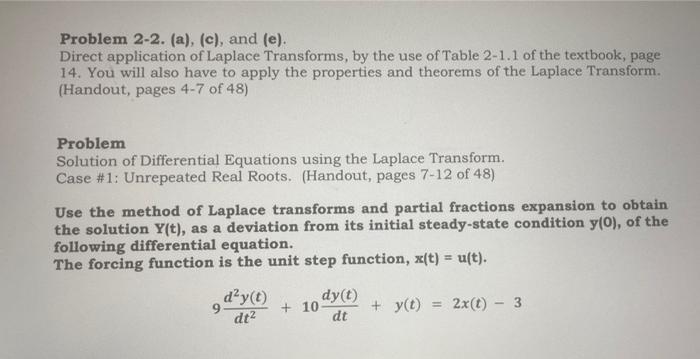
Problem 2-2. (a), (c), and (e). Direct application of Laplace Transforms, by the use of Table 2-1.1 of the textbook, page 14. You will also have to apply the properties and theorems of the Laplace Transform. (Handout, pages 4-7 of 48) Problem Solution of Differential Equations using the Laplace Transform. Case #1: Unrepeated Real Roots. (Handout, pages 7-12 of 48) Use the method of Laplace transforms and partial fractions expansion to obtain the solution y(t), as a deviation from its initial steady-state condition y(0), of the following differential equation. The forcing function is the unit step function, x(t) = u(t). dyt) dy(t) + 10 dt 9 + x(t). 2x) 3 dt2
Step by Step Solution
There are 3 Steps involved in it

Get step-by-step solutions from verified subject matter experts
 Study Help