







Question: Problem 2.2 Consider the storage tank example (Example 1.4) with K = 0.8. (a) Define the system (sysl) in state-space form using the MATLAB command
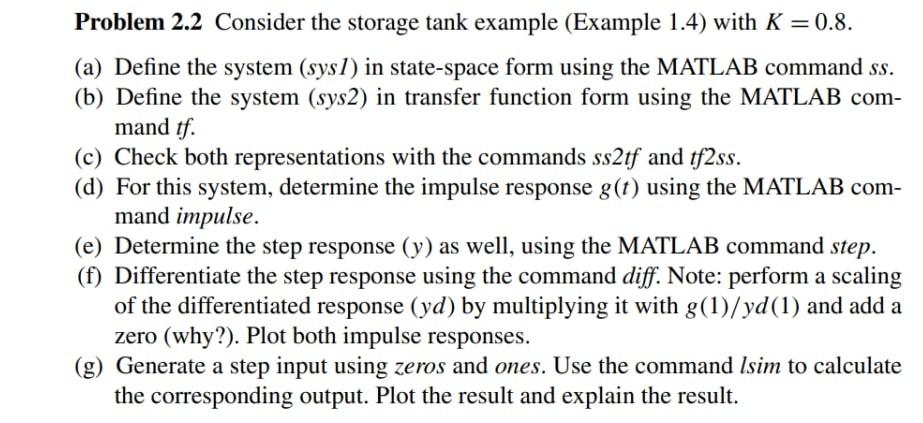
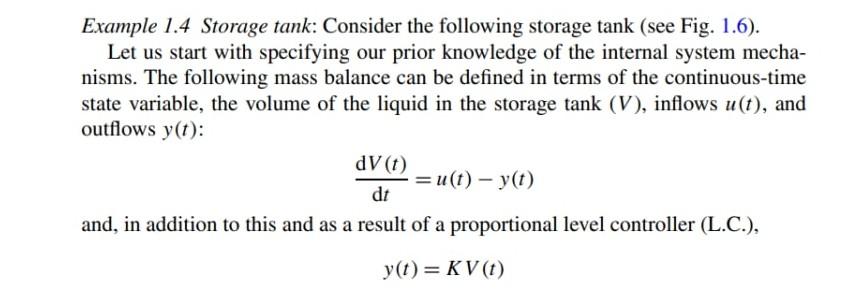
Problem 2.2 Consider the storage tank example (Example 1.4) with K = 0.8. (a) Define the system (sysl) in state-space form using the MATLAB command ss. (b) Define the system (sys2) in transfer function form using the MATLAB com- mand tf. (c) Check both representations with the commands ss2tf and tf2ss. (d) For this system, determine the impulse response g(t) using the MATLAB com- mand impulse. (e) Determine the step response (y) as well, using the MATLAB command step. (f) Differentiate the step response using the command diff. Note: perform a scaling of the differentiated response (yd) by multiplying it with g(1)/yd(1) and add a zero (why?). Plot both impulse responses. (g) Generate a step input using zeros and ones. Use the command Isim to calculate the corresponding output. Plot the result and explain the result. Example 1.4 Storage tank: Consider the following storage tank (see Fig. 1.6). Let us start with specifying our prior knowledge of the internal system mecha- nisms. The following mass balance can be defined in terms of the continuous-time state variable, the volume of the liquid in the storage tank (V), inflows u(t), and outflows y(t): dV () = u(t) y(t) dt and, in addition to this and as a result of a proportional level controller (L.C.), y(t) = KV (1) Problem 2.2 Consider the storage tank example (Example 1.4) with K = 0.8. (a) Define the system (sysl) in state-space form using the MATLAB command ss. (b) Define the system (sys2) in transfer function form using the MATLAB com- mand tf. (c) Check both representations with the commands ss2tf and tf2ss. (d) For this system, determine the impulse response g(t) using the MATLAB com- mand impulse. (e) Determine the step response (y) as well, using the MATLAB command step. (f) Differentiate the step response using the command diff. Note: perform a scaling of the differentiated response (yd) by multiplying it with g(1)/yd(1) and add a zero (why?). Plot both impulse responses. (g) Generate a step input using zeros and ones. Use the command Isim to calculate the corresponding output. Plot the result and explain the result. Example 1.4 Storage tank: Consider the following storage tank (see Fig. 1.6). Let us start with specifying our prior knowledge of the internal system mecha- nisms. The following mass balance can be defined in terms of the continuous-time state variable, the volume of the liquid in the storage tank (V), inflows u(t), and outflows y(t): dV () = u(t) y(t) dt and, in addition to this and as a result of a proportional level controller (L.C.), y(t) = KV (1)
Step by Step Solution
There are 3 Steps involved in it

Get step-by-step solutions from verified subject matter experts
 Study Help