







Question: Problem 2.25 [10] Translate the following C code to RISC-V assembly code. Use a minimum number of instructions. Assume that the values of a, b,
![Problem 2.25 [10] Translate the following C code to RISC-V assembly](https://dsd5zvtm8ll6.cloudfront.net/si.experts.images/questions/2024/09/66f2f622af4ab_75466f2f6223f47f.jpg)
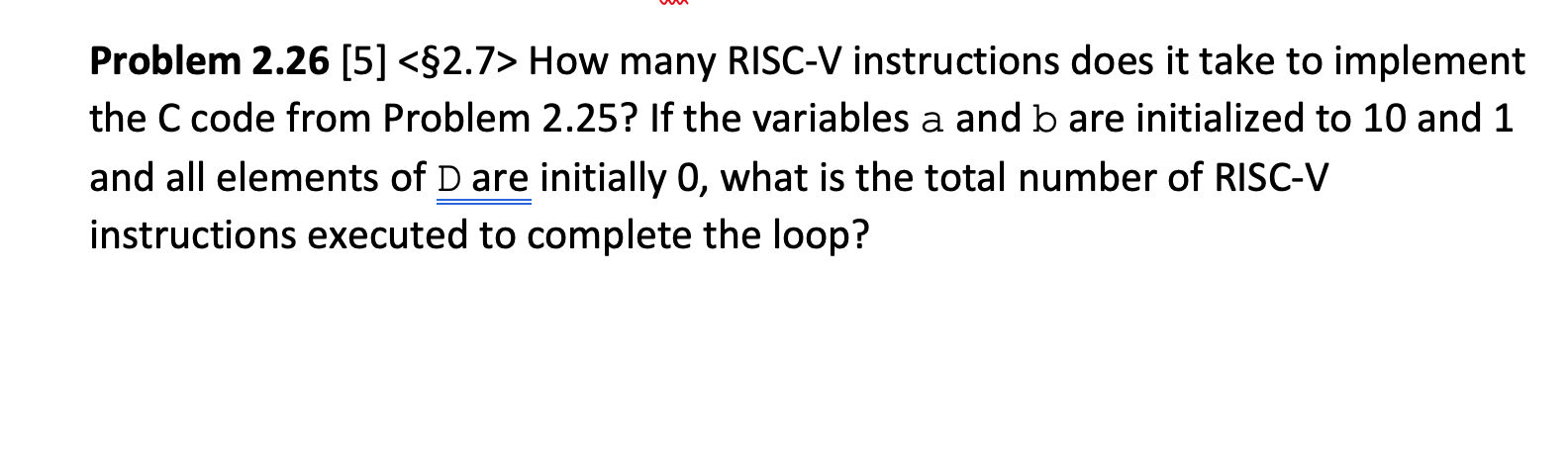
Problem 2.25 [10] Translate the following C code to RISC-V assembly code. Use a minimum number of instructions. Assume that the values of a, b, i, and jare in registers x5, X6, x7, and x29, respectively. Also assume that register x10 hold the base address of the array D. for (i=0; i How many RISC-V instructions does it take to implement the C code from Problem 2.25? If the variables a and b are initialized to 10 and 1 and all elements of D are initially 0, what is the total number of RISC-V instructions executed to complete the loop? Problem 2.25 [10] Translate the following C code to RISC-V assembly code. Use a minimum number of instructions. Assume that the values of a, b, i, and jare in registers x5, X6, x7, and x29, respectively. Also assume that register x10 hold the base address of the array D. for (i=0; i How many RISC-V instructions does it take to implement the C code from Problem 2.25? If the variables a and b are initialized to 10 and 1 and all elements of D are initially 0, what is the total number of RISC-V instructions executed to complete the loop
Step by Step Solution
There are 3 Steps involved in it

Get step-by-step solutions from verified subject matter experts
 Study Help