







Question: Problem 2.3 please and please explain your answer if possible! Thank you! Problem 2.2, p. 42, 6th Ed Solution: Relation between T and elevation: The
Problem 2.3 please and please explain your answer if possible! Thank you!
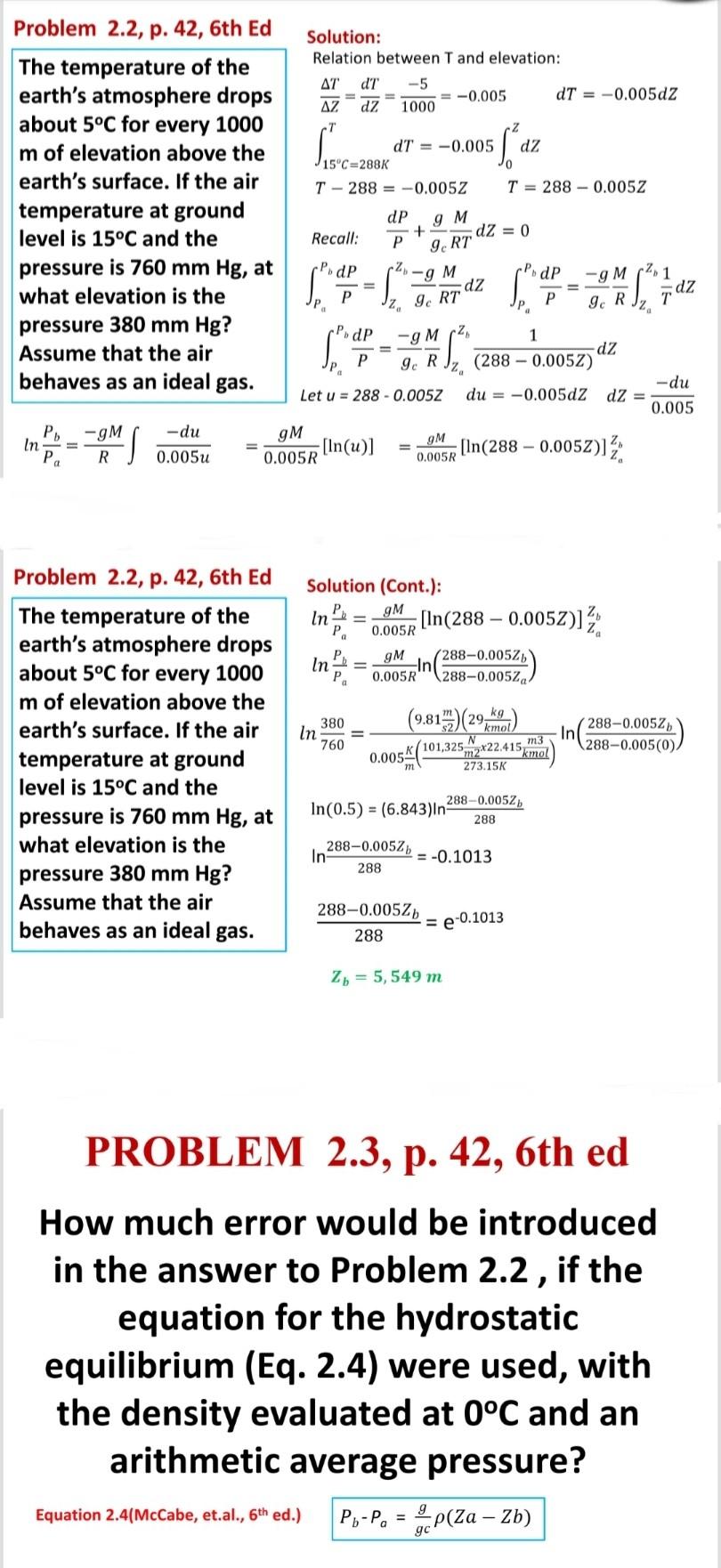
Problem 2.2, p. 42, 6th Ed Solution: Relation between T and elevation: The temperature of the AT dT --5 earth's atmosphere drops = -0.005 dT = -0.005dZ AZ dz 1000 about 5C for every 1000 T m of elevation above the d . = -0.005 dz 15C=288K earth's surface. If the air T-288 = -0.005Z T = 288 -0.005Z temperature at ground dP 9 M level is 15C and the + Recall: dZ = 0 P pressure is 760 mm Hg, at cz Podp -gM Z 1 what elevation is the dz dz z 9. R T Uz pressure 380 mm Hg? dP 1 Assume that the air dz 9. R (288 -0.0057) behaves as an ideal gas. za -du Let u = 288 -0.005Z du = -0.005dZ dZ = 0.005 P) -OM -du gM In [In(u)] gM Pa [ln(288 - 0.0052)]2 R 0.005 0.005R 0.005R PdP I RT 9M 9. RT -gM rz, S gM Solution (Cont.): In? [In(288 0.0052)]2 0.005R gM (288-0.00526 -In P 0.005R 288-0.0052a In L (9.81") (29 kg 380 In 760 In Problem 2.2, p. 42, 6th Ed The temperature of the earth's atmosphere drops about 5C for every 1000 m of elevation above the earth's surface. If the air temperature at ground level is 15C and the pressure is 760 mm Hg, at what elevation is the pressure 380 mm Hg? Assume that the air behaves as an ideal gas. 288-0.0052 (288-0.005(0) 0.005 kmol m3 5x22.415 kmol 273.15K (101,325 m2 288-0.0052b In(0.5) = (6.843)In 288 288-0.0052 In = -0.1013 288 288-0.005Z 288 = e -0.1013 Zn = 5,549 m PROBLEM 2.3, p. 42, 6th ed 9 How much error would be introduced in the answer to Problem 2.2, if the equation for the hydrostatic equilibrium (Eq. 2.4) were used, with the density evaluated at 0C and an arithmetic average pressure? P-Po = P(Za zb) Equation 2.4(McCabe, et.al., 6th ed.)
Step by Step Solution
There are 3 Steps involved in it

Get step-by-step solutions from verified subject matter experts
 Study Help