







Question: Problem (25 points) This problem involves hypothesis testing of exponentially distributed data. Let Y1,Y2,--- ,3; be i.i.d. random variables from an exponential distribution with rate

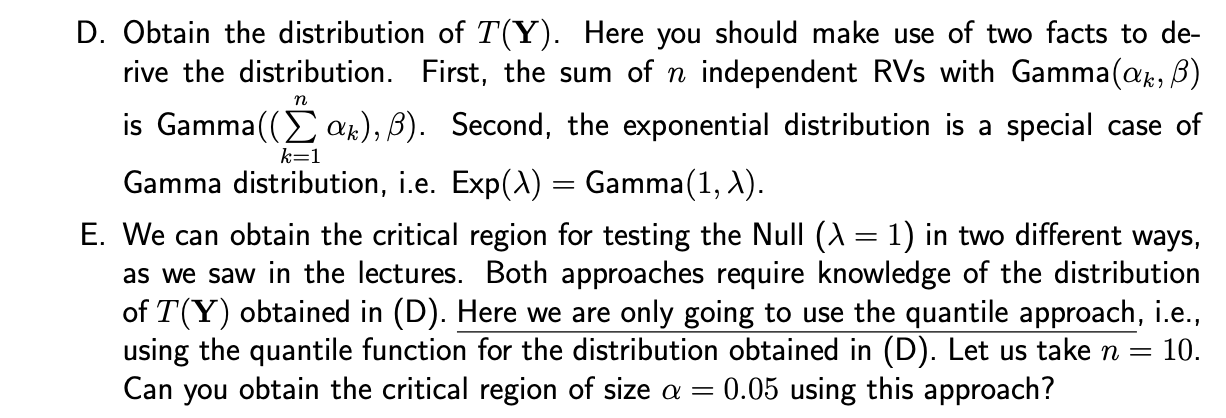

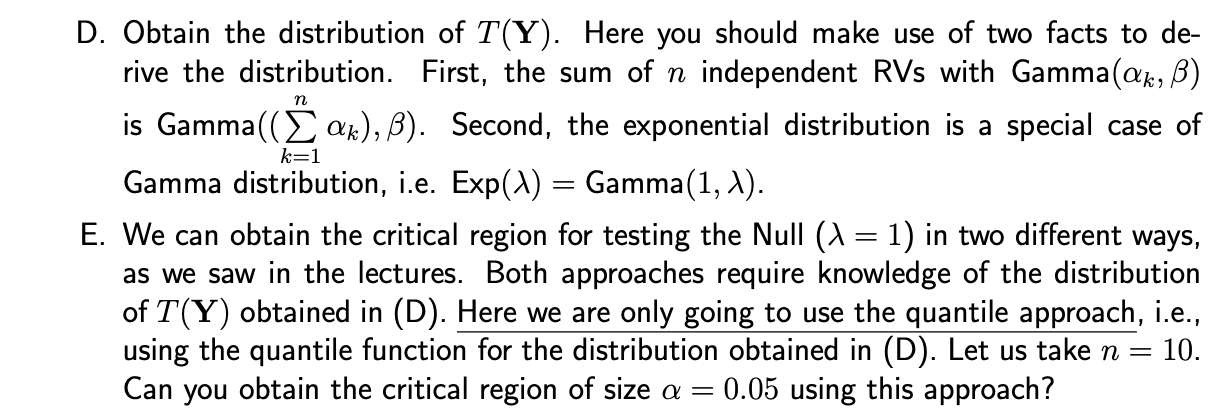
Problem (25 points) This problem involves hypothesis testing of exponentially distributed data. Let Y1,Y2,--- ,3; be i.i.d. random variables from an exponential distribution with rate parameter A. The density of an exponential is given as: f(Y;) = Aexp(AY;), 2' = 1, 2, - - - ,n. We want to test the hypothesis that the data comes from a unit exponential, i.e. A = 1. D. Obtain the distribution of T(Y). Here you should make use of two facts to de rive the distribution. First, the sum of n independent RVs with Gamma(ok,) is Gamma\": oak),). Second, the exponential distribution is a special case of k=1 Gamma distribution, i.e. Exp()\\) = Gamma(1,)\\). E. We can obtain the critical region for testing the Null (A = 1) in two different ways, as we saw in the lectures. Both approaches require knowledge of the distribution of T(Y) obtained in (D). Here we are only going to use the quantile approach, i.e., using the quantile function for the distribution obtained in (D). Let us take n = 10. Can you obtain the critical region of size a = 0.05 using this approach
Step by Step Solution
There are 3 Steps involved in it

Get step-by-step solutions from verified subject matter experts
 Study Help