







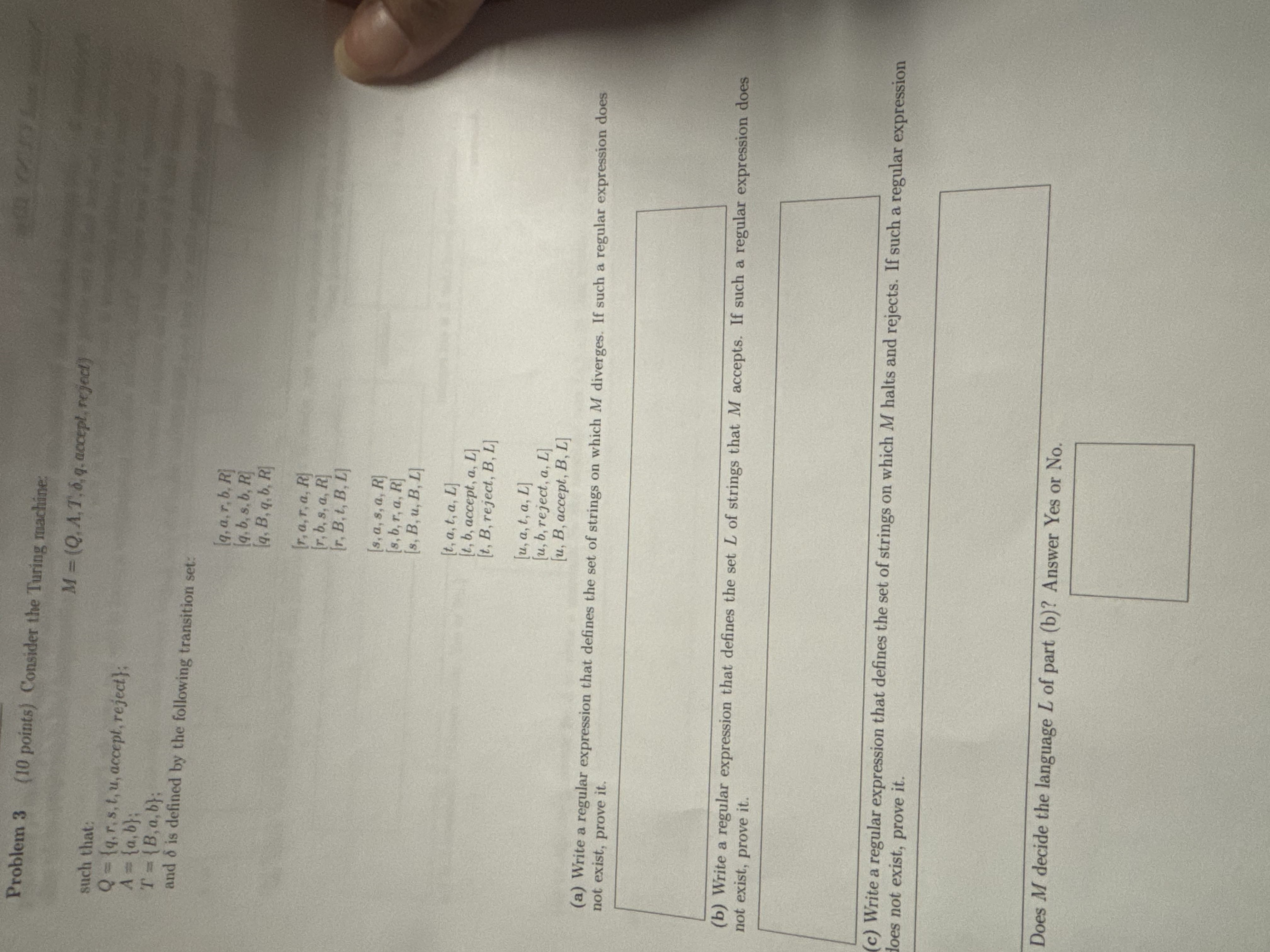
Question: Problem 3 ( 1 0 points ) Consider the Turing machine: M = ( Q , A , T , , q , accept, neyect
Problem points Consider the Turing machine:
accept, neyect
such that:
accept,reject;
;
;
and is defined by the following transition set:
accept,
reject,
reject,
accept,
a Write a regular expression that defines the set of strings on which diverges. If such a regular expression does not exist, prove it
b Write a regular expression that defines the set of strings that accepts. If such a regular expression does not exist, prove it
c Write a regular expression that defines the set of strings on which halts and rejects. If such a regular expression loes not exist, prove it
Does decide the language of part b Answer Yes or No
Step by Step Solution
There are 3 Steps involved in it
1 Expert Approved Answer
Step: 1 Unlock

Question Has Been Solved by an Expert!
Get step-by-step solutions from verified subject matter experts
Step: 2 Unlock
Step: 3 Unlock
 Study Help