







Question: Problem 3 ( 1 0 Points ) One simple experiment used to characterize abrasive wear is to have a very hard cone ( assumed to
Problem Points
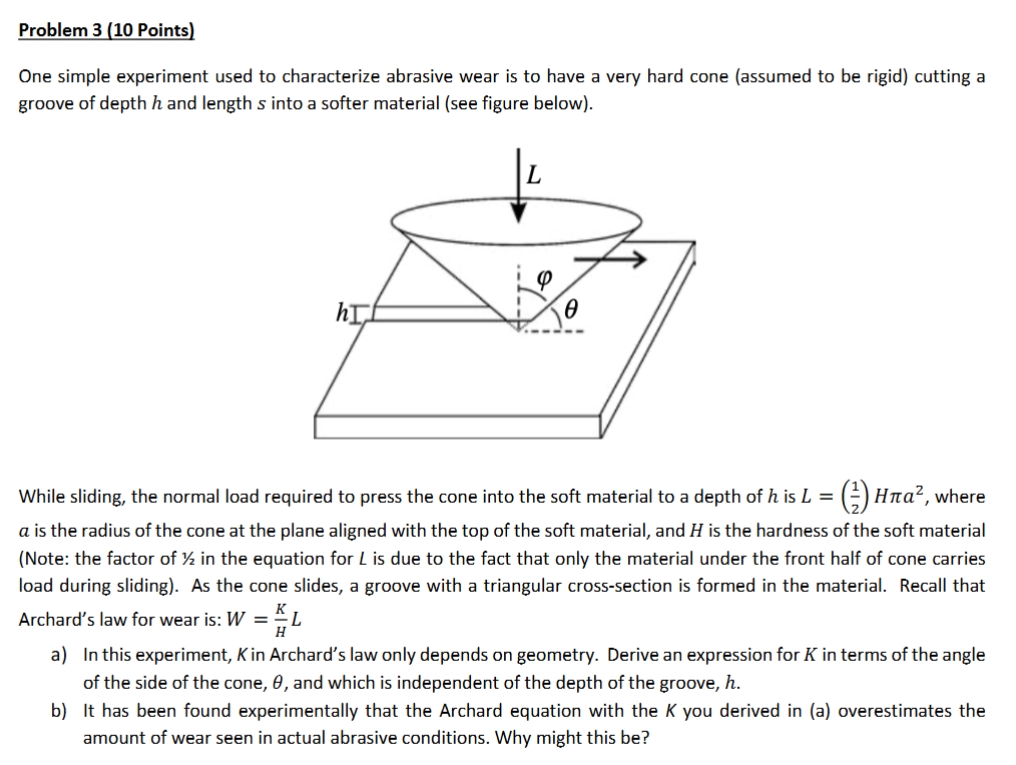
One simple experiment used to characterize abrasive wear is to have a very hard cone assumed to be rigid cutting a groove of depth h and length s into a softer material see figure below
While sliding, the normal load required to press the cone into the soft material to a depth of h is Lleftfracright H pi a where a is the radius of the cone at the plane aligned with the top of the soft material, and H is the hardness of the soft material Note: the factor of in the equation for L is due to the fact that only the material under the front half of cone carries load during sliding As the cone slides, a groove with a triangular crosssection is formed in the material. Recall that Archard's law for wear is: WfracKH L
a In this experiment, K in Archard's law only depends on geometry. Derive an expression for K in terms of the angle of the side of the cone, theta and which is independent of the depth of the groove, h
b It has been found experimentally that the Archard equation with the K you derived in a overestimates the amount of wear seen in actual abrasive conditions. Why might this be
Step by Step Solution
There are 3 Steps involved in it
1 Expert Approved Answer
Step: 1 Unlock

Question Has Been Solved by an Expert!
Get step-by-step solutions from verified subject matter experts
Step: 2 Unlock
Step: 3 Unlock
 Study Help