







Question: ( Problem 3 . 1 1 in the textbook ) A Turing machine with doubly infinite tape is similar to an ordinary Turing machine, but
Problem in the textbook A Turing machine with doubly
infinite tape is similar to an ordinary Turing machine, but its
tape is infinite to the left as well as to the right. The tape is
initially filled with blanks except for the portion that contains
the input. Computation is defined as usual except that the head
never encounters an end to the tape as it moves leftward. Show
that this if a Turing machine of this type accepts a language
then there is a regular Turing machine as defined in class
which also accepts
Hint: Suppose that the twoway infinite tape of the machine
contains input for some input
symbols which is preceded and followed by infinitely
many blanks to the left and to the right.
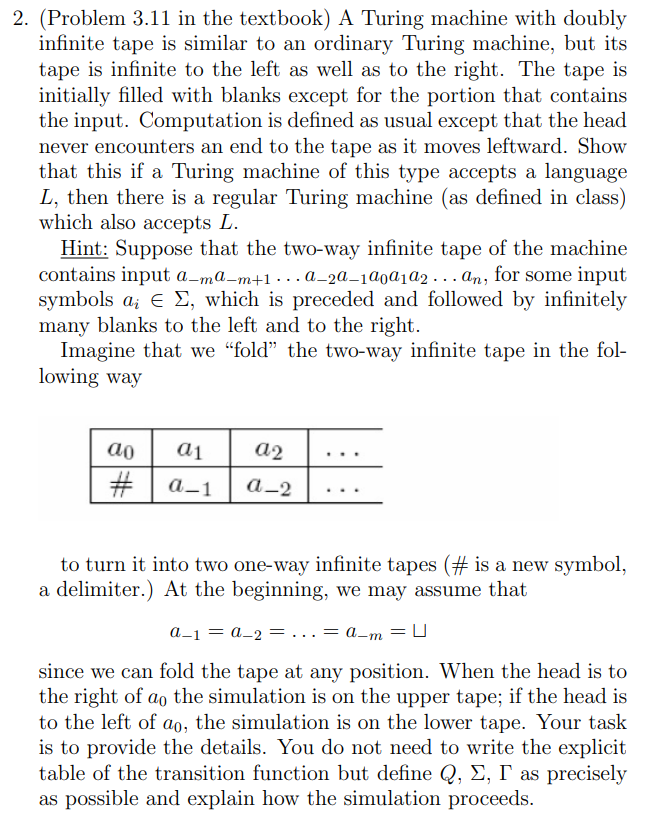
Imagine that we "fold" the twoway infinite tape in the fol
lowing way
to turn it into two oneway infinite tapes # is a new symbol,
a delimiter. At the beginning, we may assume that
dots
since we can fold the tape at any position. When the head is to
the right of the simulation is on the upper tape; if the head is
to the left of the simulation is on the lower tape. Your task
is to provide the details. You do not need to write the explicit
table of the transition function but define as precisely
as possible and explain how the simulation proceeds.
Step by Step Solution
There are 3 Steps involved in it
1 Expert Approved Answer
Step: 1 Unlock

Question Has Been Solved by an Expert!
Get step-by-step solutions from verified subject matter experts
Step: 2 Unlock
Step: 3 Unlock
 Study Help