







Question: Problem 3 ( 1 2 pts ) D . B . Tuckerman and R . F . Pease of Stanford University demonstrated in the early
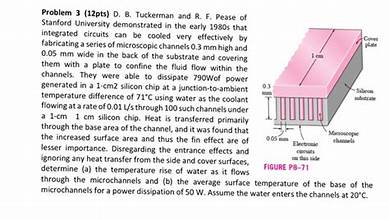
Problem pts D B Tuckerman and R F Pease of Stanford University demonstrated in the early s that integrated circuits can be cooled very effectively by fabricating a series of microscopic channeks mm high and mm wide in the back of the substrate and covering them with a plate to confine the fluid flow within the channels. They were able to dissipate Wof power generated in a cdot mathrm~cm slicon chip at a junctiontoambient temperature difference of circmathrmC using water as the coolant flowing at a rate of mathrmUmathrms through such channels under a mathrmcmmathrm~cm silicon chip. Heat is transferred primarily through the base area of the channel, and it was found that the increased surface area and thus the fin effect are of lesser importance. Disfegarding the entrance effects and ignoring any heat transfer from the side and cover surfaces, determine a the temperature rise of water as it flows through the microchannels and b the awerage surface temperature of the base of the microchannels for a power dissipation of W Assume the water enters the chaneels at circmathrmC
Step by Step Solution
There are 3 Steps involved in it
1 Expert Approved Answer
Step: 1 Unlock

Question Has Been Solved by an Expert!
Get step-by-step solutions from verified subject matter experts
Step: 2 Unlock
Step: 3 Unlock
 Study Help