







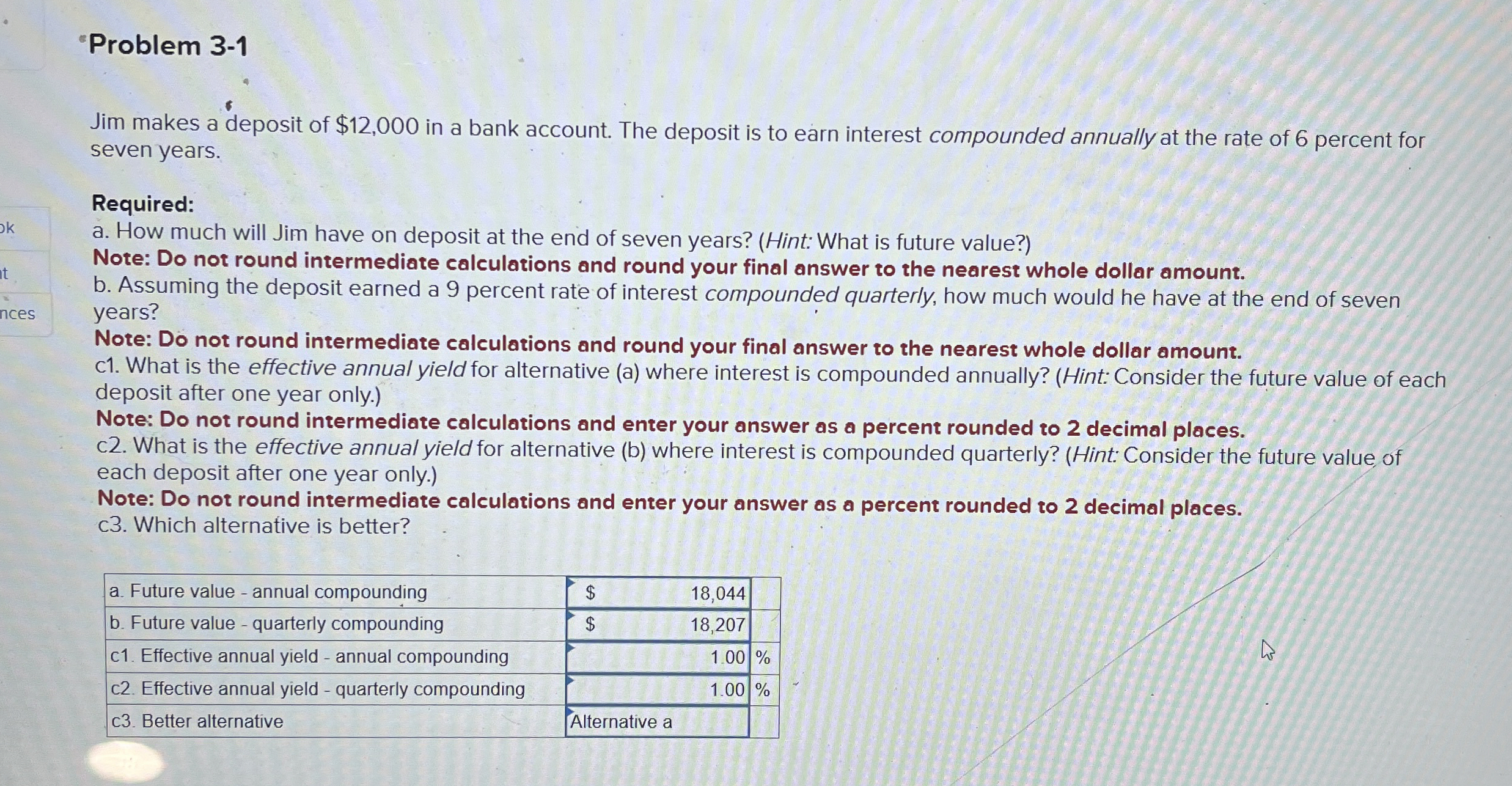
Question: ? ? Problem 3 - 1 Jim makes a deposit of $ 1 2 , 0 0 0 in a bank account. The deposit is
Problem
Jim makes a deposit of $ in a bank account. The deposit is to earn interest compounded annually at the rate of percent for seven years.
Required:
a How much will Jim have on deposit at the end of seven years? Hint: What is future value?
Note: Do not round intermediate calculations and round your final answer to the nearest whole dollar amount.
b Assuming the deposit earned a percent rate of interest compounded quarterly, how much would he have at the end of seven years?
Note: Do not round intermediate calculations and round your final answer to the nearest whole dollar amount.
c What is the effective annual yield for alternative a where interest is compounded annually? Hint: Consider the future value of each deposit after one year only.
Note: Do not round intermediate calculations and enter your answer as a percent rounded to decimal places.
c What is the effective annual yield for alternative b where interest is compounded quarterly? Hint: Consider the future value of each deposit after one year only.
Note: Do not round intermediate calculations and enter your answer as a percent rounded to decimal places.
c Which alternative is better?
tablea Future value annual compounding,$b Future value quarterly compounding,$c Effective annual yield annual compounding,,
Step by Step Solution
There are 3 Steps involved in it
1 Expert Approved Answer
Step: 1 Unlock

Question Has Been Solved by an Expert!
Get step-by-step solutions from verified subject matter experts
Step: 2 Unlock
Step: 3 Unlock
 Study Help