







Question: Problem 3. (1 point) Problem 5. (1 point) For this problem, you will need to use the Desmos Riemann Sum Caldalatorproblem you will calculate the
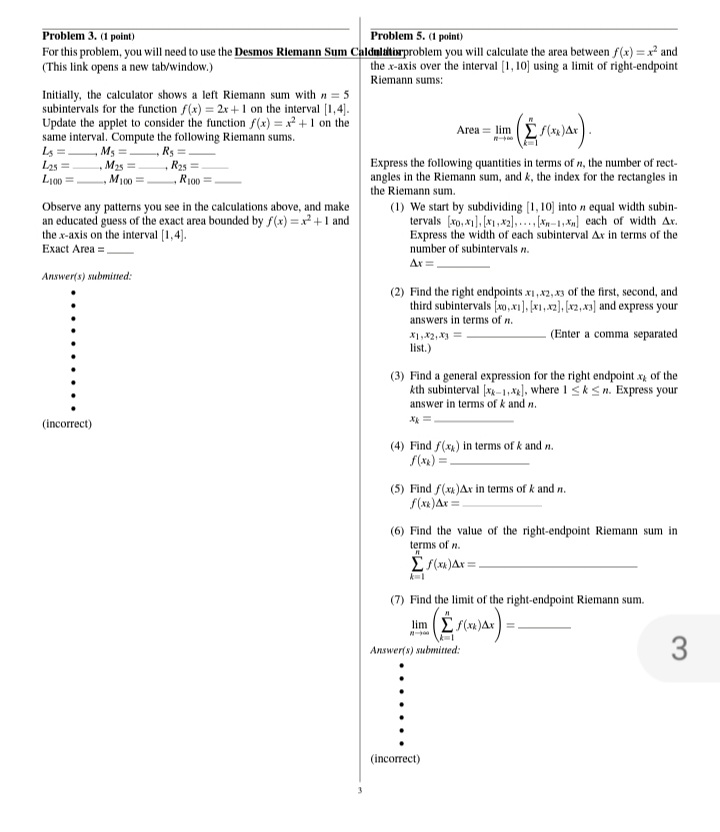
Problem 3. (1 point) Problem 5. (1 point) For this problem, you will need to use the Desmos Riemann Sum Caldalatorproblem you will calculate the area between f(x) = x and "This link opens a new tab/window.) the x-axis over the interval [1, 10] using a limit of right-endpoint Riemann sums: Initially, the calculator shows a left Riemann sum with n = 5 subintervals for the function /(x) = 2x + 1 on the interval [1, 4]. Update the applet to consider the function f(x) = x + 1 on the same interval. Compute the following Riemann sums. Area = lim L=. M.=. Express the following quantities in terms of n, the number of rect- LIOO = . Mico= Rion = angles in the Riemann sum, and &, the index for the rectangles in the Riemann sum. Observe any patterns you see in the calculations above, and make (1) We start by subdividing [1, 10] into a equal width subin- an educated guess of the exact area bounded by f(x) =x + 1 and tervals [xo, x], [x1,*2],.... [*n-1,a] each of width Ar. the x-axis on the interval [1, 4]. Express the width of each subinterval Ax in terms of the Exact Area = number of subintervals n. Ar= Answer(s) submitted: (2) Find the right endpoints x1, x2, x3 of the first, second, and third subintervals [x,xi], [x1, x2], [x2, x3] and express your answers in terms of n. (Enter a comma separated list.) . . (3) Find a general expression for the right endpoint xx of the Ath subinterval [xx-1,x]. where I
Step by Step Solution
There are 3 Steps involved in it

Get step-by-step solutions from verified subject matter experts
 Study Help