







Question: Problem 3 (10 Points): The fraction non-conforming for a product is being monitored by a P Chart. Part (a): (5 Points) Now, suppose that the
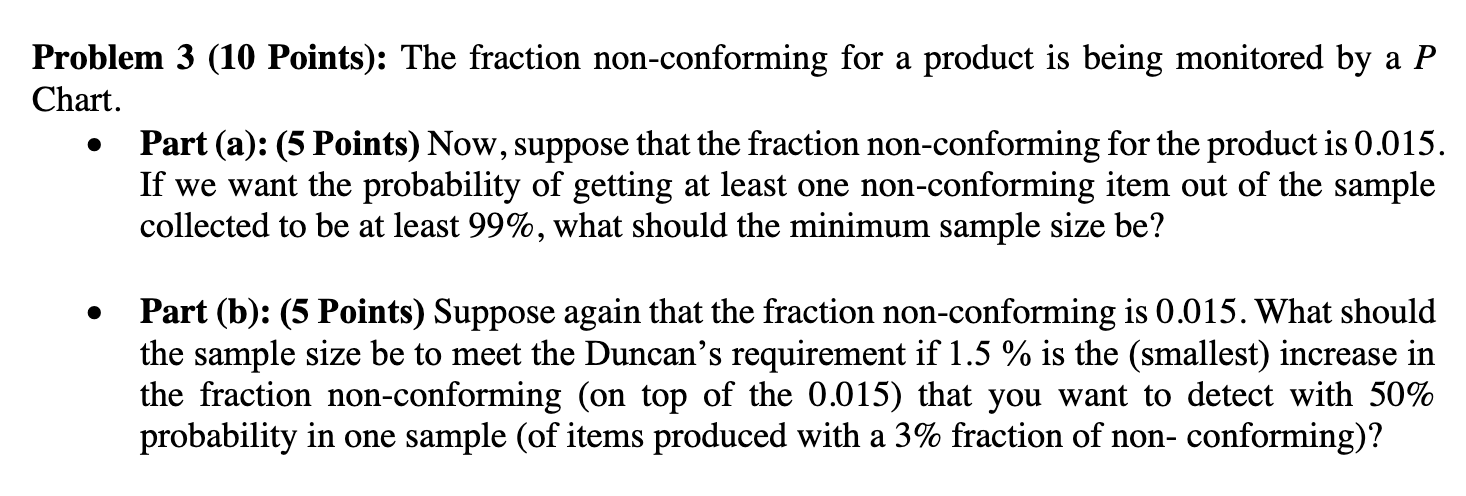
Problem 3 (10 Points): The fraction non-conforming for a product is being monitored by a P Chart. Part (a): (5 Points) Now, suppose that the fraction non-conforming for the product is 0.015. If we want the probability of getting at least one non-conforming item out of the sample collected to be at least 99%, what should the minimum sample size be? . . Part (b): (5 Points) Suppose again that the fraction non-conforming is 0.015. What should the sample size be to meet the Duncan's requirement if 1.5 % is the (smallest) increase in the fraction non-conforming (on top of the 0.015) that you want to detect with 50% probability in one sample (of items produced with a 3% fraction of non-conforming)? a Problem 3 (10 Points): The fraction non-conforming for a product is being monitored by a P Chart. Part (a): (5 Points) Now, suppose that the fraction non-conforming for the product is 0.015. If we want the probability of getting at least one non-conforming item out of the sample collected to be at least 99%, what should the minimum sample size be? . . Part (b): (5 Points) Suppose again that the fraction non-conforming is 0.015. What should the sample size be to meet the Duncan's requirement if 1.5 % is the (smallest) increase in the fraction non-conforming (on top of the 0.015) that you want to detect with 50% probability in one sample (of items produced with a 3% fraction of non-conforming)? a
Step by Step Solution
There are 3 Steps involved in it

Get step-by-step solutions from verified subject matter experts
 Study Help