







Question: Problem 3 (18 pts). A researcher is developing a new drug for reducing pain. To test the eifectiveness of the new drug, the researcher obtained
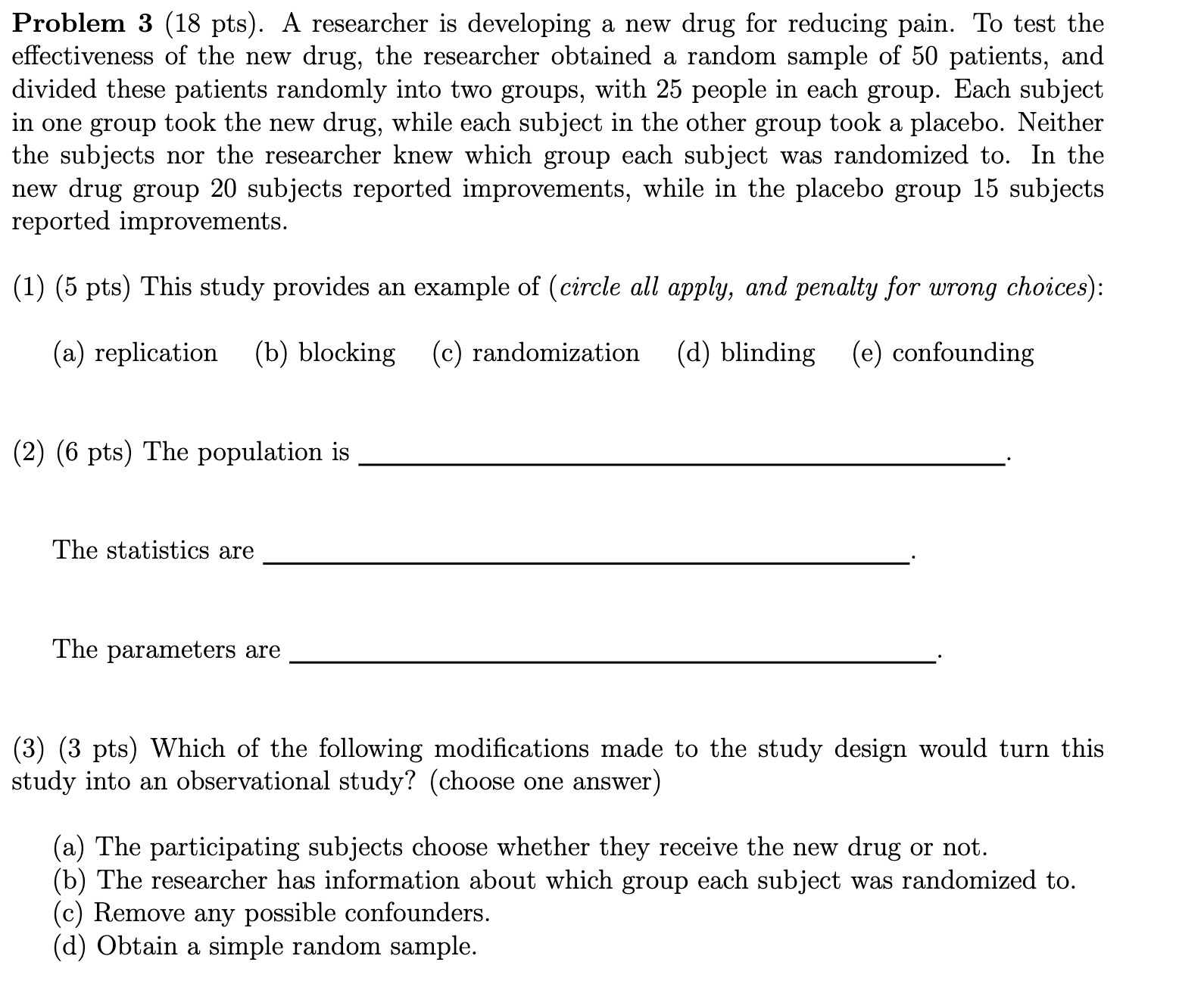
Problem 3 (18 pts). A researcher is developing a new drug for reducing pain. To test the eifectiveness of the new drug, the researcher obtained a random sample of 50 patients, and divided these patients randomly into two groups, with 25 people in each group. Each subject in one group took the new drug, while each subject in the other group took a placebo. Neither the subjects nor the researcher knew which group each subject was randomized to. In the new drug group 20 subjects reported improvements, while in the placebo group 15 subjects reported improvements. (1) (5 pts) This study provides an example of (circle all apply, and penalty for wrong choices): (a) replication (b) blocking (c) randomization (d) blinding (e) confounding (2) (6 pts) The pOpulation is The statistics are The parameters are (3) (3 pts) Which of the following modications made to the study design would turn this study into an observational study? (choose one answer) a) The participating subjects choose whether they receive the new drug or not. b) The researcher has information about which group each subject was randomized to. c ) Remove any possible confounders. d) Obtain a simple random sample. ( ( ( (
Step by Step Solution
There are 3 Steps involved in it

Get step-by-step solutions from verified subject matter experts
 Study Help