







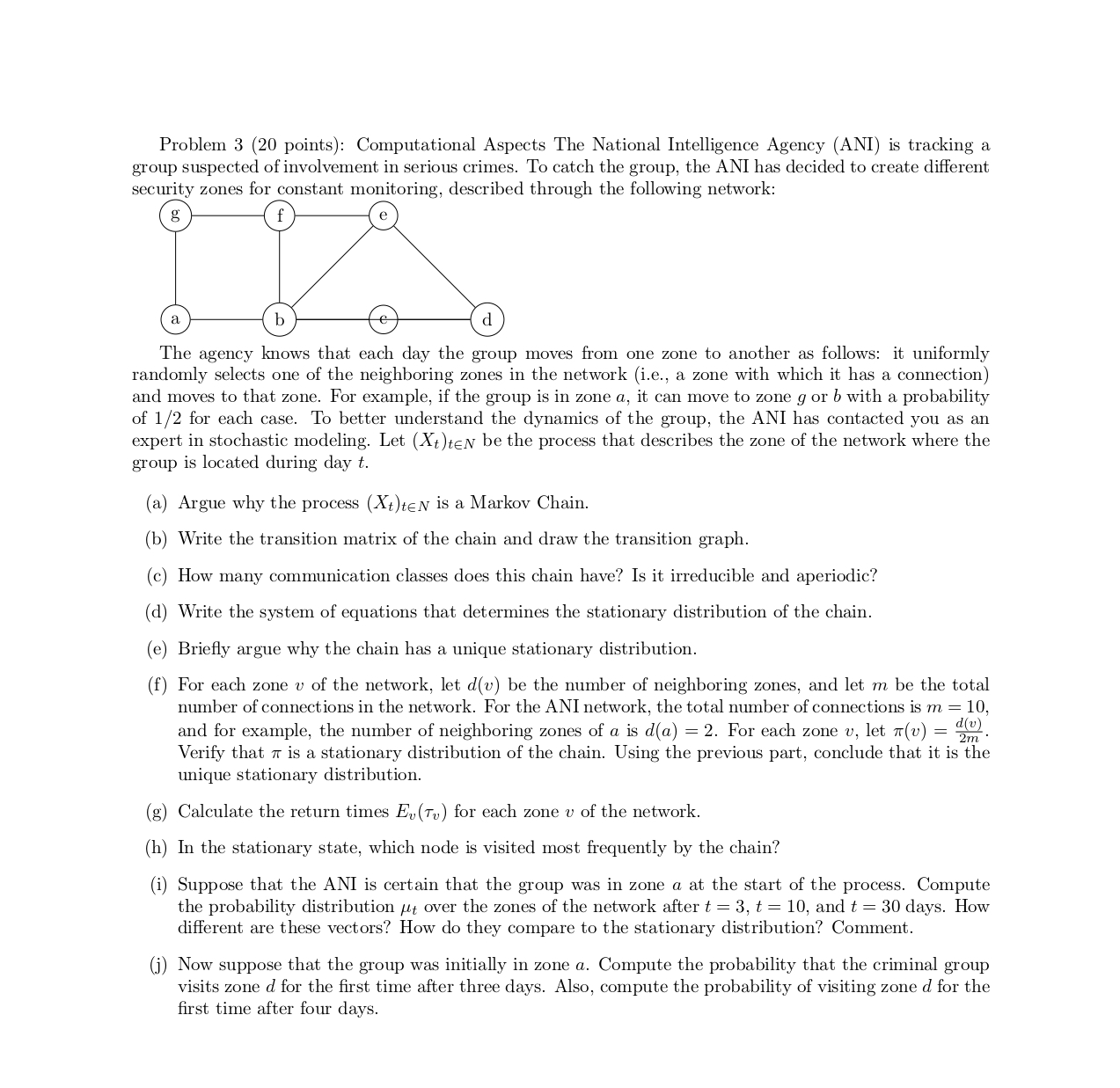
Question: Problem 3 ( 2 0 points ) : Computational Aspects The National Intelligence Agency ( ANI ) is tracking a group suspected of involvement in
Problem points: Computational Aspects The National Intelligence Agency ANI is tracking a
group suspected of involvement in serious crimes. To catch the group, the ANI has decided to create different
security zones for constant monitoring. described through the following network:
The agency knows that each day the group moves from one zone to another as follows: it uniformly
randomly selects one of the neighboring zones in the network ie a zone with which it has a connection
and moves to that zone. For example, if the group is in zone it can move to zone or with a probability
of for each case. To better understand the dynamics of the group, the ANI has contacted you as an
expert in stochastic modeling. Let be the process that describes the zone of the network where the
group is located during day
a Argue why the process is a Markov Chain.
b Write the transition matrix of the chain and draw the transition graph.
c How many communication classes does this chain have? Is it irreducible and aperiodic?
d Write the system of equations that determines the stationary distribution of the chain.
e Briefly argue why the chain has a unique stationary distribution.
f For each zone of the network, let be the number of neighboring zones, and let be the total
number of connections in the network. For the ANI network, the total number of connections is
and for example, the number of neighboring zones of is For each zone let
Verify that is a stationary distribution of the chain. Using the previous part, conclude that it is the
unique stationary distribution.
g Calculate the return times for each zone of the network.
h In the stationary state, which node is visited most frequently by the chain?
i Suppose that the ANI is certain that the group was in zone at the start of the process. Compute
the probability distribution over the zones of the network after and days. How
different are these vectors? How do they compare to the stationary distribution? Comment.
j Now suppose that the group was initially in zone Compute the probability that the criminal group
visits zone for the first time after three days. Also, compute the probability of visiting zone for the
first time after four days.
Step by Step Solution
There are 3 Steps involved in it
1 Expert Approved Answer
Step: 1 Unlock

Question Has Been Solved by an Expert!
Get step-by-step solutions from verified subject matter experts
Step: 2 Unlock
Step: 3 Unlock
 Study Help