







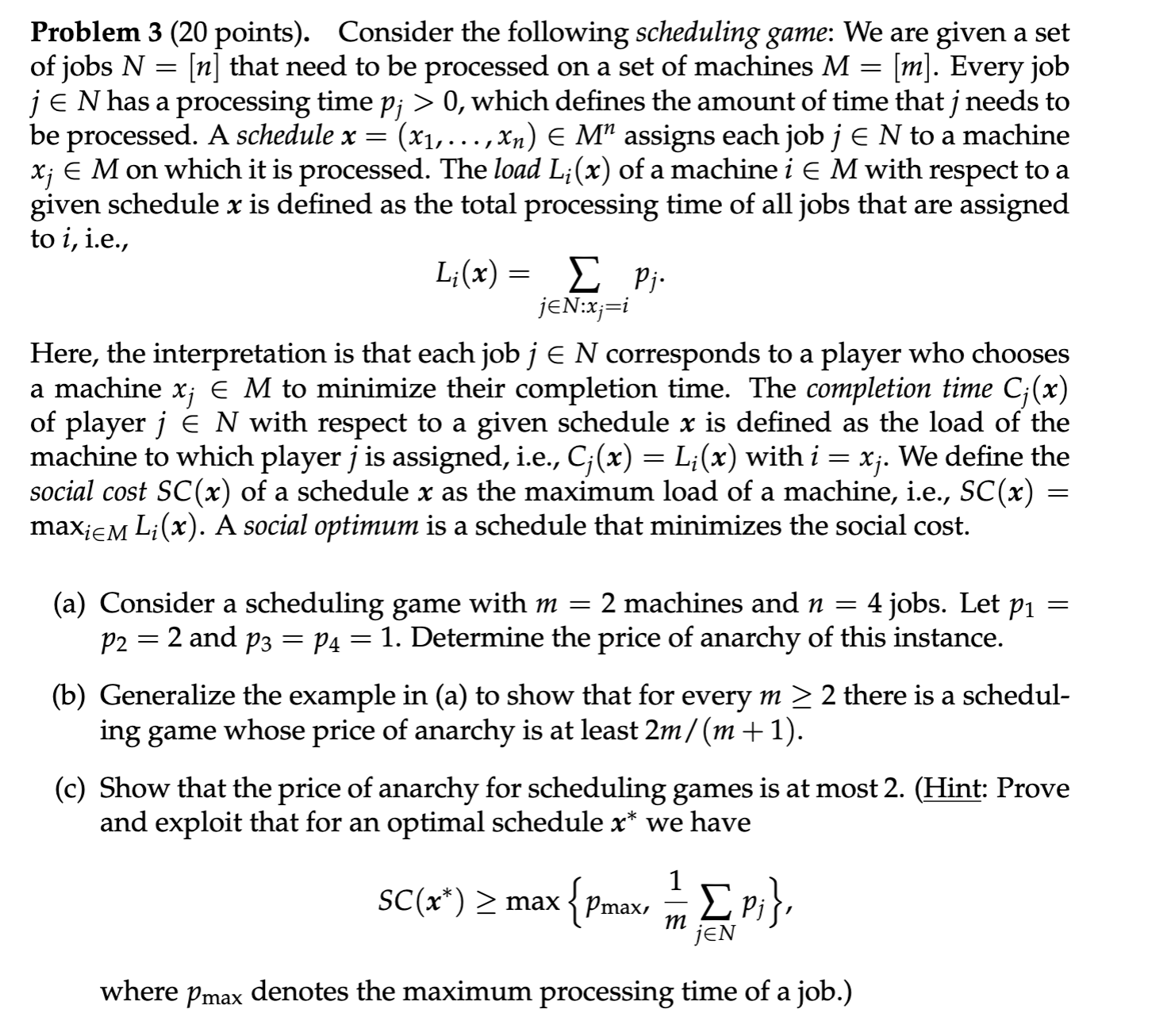
Question: Problem 3 ( 2 0 points ) . Consider the following scheduling game: We are given a set of jobs N = [ n ]
Problem points Consider the following scheduling game: We are given a set
of jobs that need to be processed on a set of machines Every job
jinN has a processing time which defines the amount of time that needs to
be processed. A schedule dots, assigns each job jinN to a machine
inM on which it is processed. The load of a machine iinM with respect to a
given schedule is defined as the total processing time of all jobs that are assigned
to ie
Here, the interpretation is that each job jinN corresponds to a player who chooses
a machine inM to minimize their completion time. The completion time
of player jinN with respect to a given schedule is defined as the load of the
machine to which player is assigned, ie with We define the
social cost of a schedule as the maximum load of a machine, ie
A social optimum is a schedule that minimizes the social cost.
a Consider a scheduling game with machines and jobs. Let
and Determine the price of anarchy of this instance.
b Generalize the example in a to show that for every there is a schedul
ing game whose price of anarchy is at least
c Show that the price of anarchy for scheduling games is at most Hint: Prove
and exploit that for an optimal schedule we have
max
where denotes the maximum processing time of a job.
Step by Step Solution
There are 3 Steps involved in it
1 Expert Approved Answer
Step: 1 Unlock

Question Has Been Solved by an Expert!
Get step-by-step solutions from verified subject matter experts
Step: 2 Unlock
Step: 3 Unlock
 Study Help