







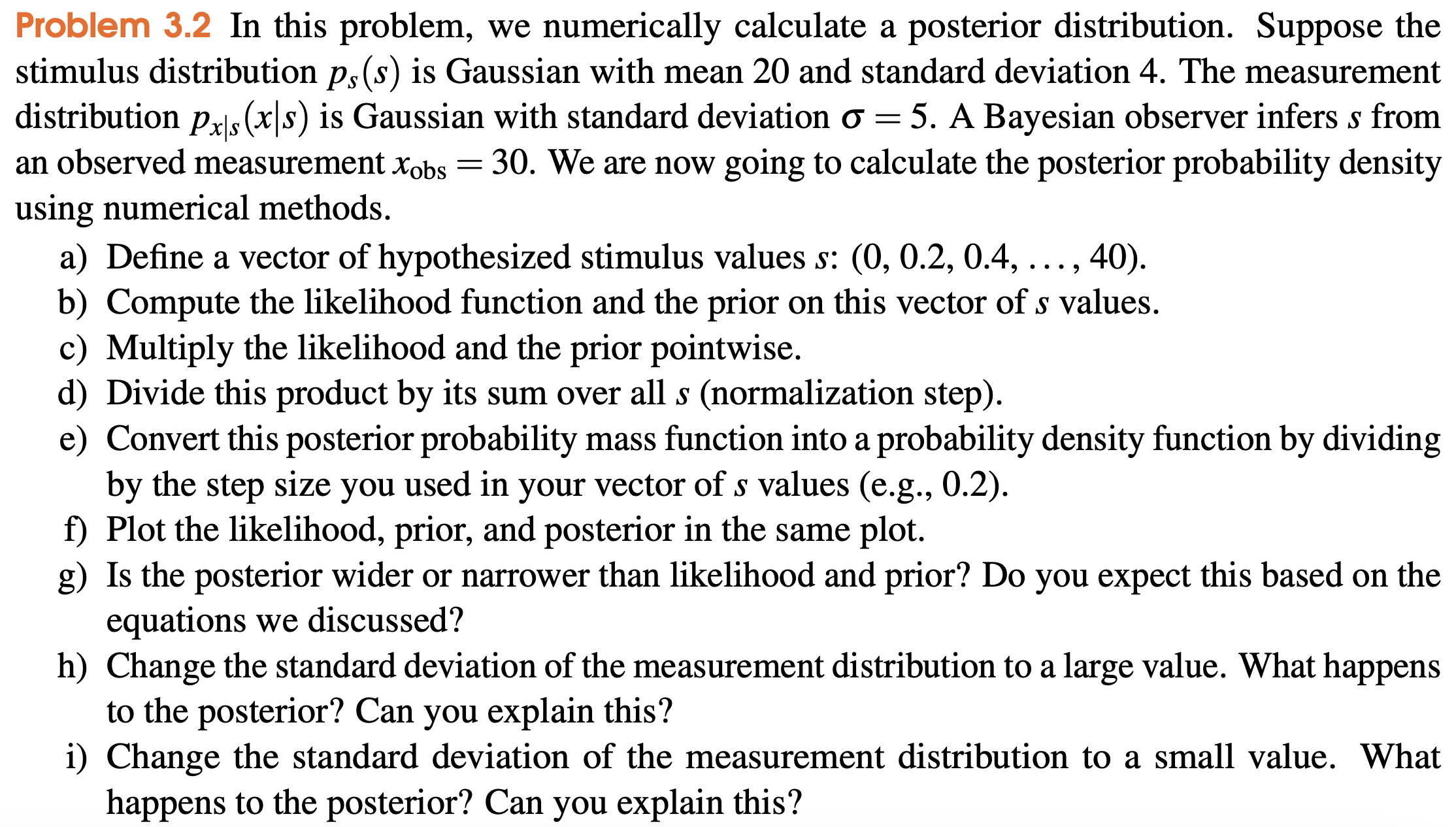
Question: Problem 3 . 2 In this problem, we numerically calculate a posterior distribution. Suppose the stimulus distribution p s ( s ) is Gaussian with
Problem In this problem, we numerically calculate a posterior distribution. Suppose the
stimulus distribution is Gaussian with mean and standard deviation The measurement
distribution is Gaussian with standard deviation A Bayesian observer infers from
an observed measurement We are now going to calculate the posterior probability density
using numerical methods.
a Define a vector of hypothesized stimulus values :dots,
b Compute the likelihood function and the prior on this vector of values.
c Multiply the likelihood and the prior pointwise.
d Divide this product by its sum over all normalization step
e Convert this posterior probability mass function into a probability density function by dividing
by the step size you used in your vector of values eg
f Plot the likelihood, prior, and posterior in the same plot.
g Is the posterior wider or narrower than likelihood and prior? Do you expect this based on the
equations we discussed?
h Change the standard deviation of the measurement distribution to a large value. What happens
to the posterior? Can you explain this?
i Change the standard deviation of the measurement distribution to a small value. What
happens to the posterior? Can you explain this?
Step by Step Solution
There are 3 Steps involved in it
1 Expert Approved Answer
Step: 1 Unlock

Question Has Been Solved by an Expert!
Get step-by-step solutions from verified subject matter experts
Step: 2 Unlock
Step: 3 Unlock
 Study Help