







Question: Problem 3 [20 Points Alice and Bob are approached by a generous company and asked to solve the following problem: The company wishes to store
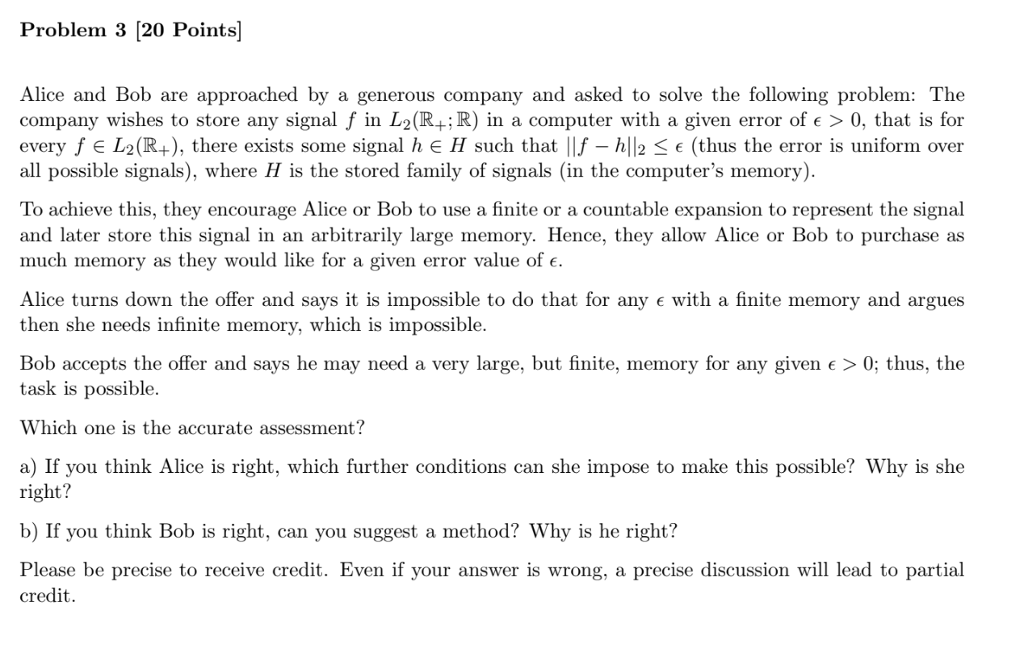
Problem 3 [20 Points Alice and Bob are approached by a generous company and asked to solve the following problem: The company wishes to store any signal f in L2 (R+R) in a computer with a given error ofe 0, that is for every f E L2(R+), there exists some signal h E H such that llf -h2 e (thus the error is uniform over all possible signals), where H is the stored family of signals (in the computer's memory) To achieve this, they encourage Alice or Bob to use a finite or a countable expansion to represent the signal and later store this signal in an arbitrarily large memory. Hence, they allow Alice or Bob to purchase as much memory as they would like for a given error value of e. Alice turns down the offer and says it is impossible to do that for any e with a finite memory and argues then she needs infinite memory, which is impossible. Bob accepts the offer and says he may need a very large, but finite, memory for any given > 0; thus, the task is possible. Which one is the accurate assessment? a) If you think Alice is right, which further conditions can she impose to make this possible? Why is she right? b) If you think Bob is right, can you suggest a method? Why is he right? Please be precise to receive credit. Even if your answer is wrong, a precise discussion will lead to partial credit Problem 3 [20 Points Alice and Bob are approached by a generous company and asked to solve the following problem: The company wishes to store any signal f in L2 (R+R) in a computer with a given error ofe 0, that is for every f E L2(R+), there exists some signal h E H such that llf -h2 e (thus the error is uniform over all possible signals), where H is the stored family of signals (in the computer's memory) To achieve this, they encourage Alice or Bob to use a finite or a countable expansion to represent the signal and later store this signal in an arbitrarily large memory. Hence, they allow Alice or Bob to purchase as much memory as they would like for a given error value of e. Alice turns down the offer and says it is impossible to do that for any e with a finite memory and argues then she needs infinite memory, which is impossible. Bob accepts the offer and says he may need a very large, but finite, memory for any given > 0; thus, the task is possible. Which one is the accurate assessment? a) If you think Alice is right, which further conditions can she impose to make this possible? Why is she right? b) If you think Bob is right, can you suggest a method? Why is he right? Please be precise to receive credit. Even if your answer is wrong, a precise discussion will lead to partial credit
Step by Step Solution
There are 3 Steps involved in it

Get step-by-step solutions from verified subject matter experts
 Study Help