







Question: Problem 3 ( 4 0 pts ) Flow through connective tissues in the body, such as cartilage, the renal glomerulus, and the interstitium, occurs through
Problem pts Flow through connective tissues in the body, such as cartilage, the renal
glomerulus, and the interstitium, occurs through complicated flow passages that are difficult
to characterize. One approach is to treat these tissues as porous media, and to apply Darcy's
law, which relates the pressure drop across a porous medium to its permeability :
Where is the fluid viscosity, is the flow rate, is the length of the porous medium in the
flowwise direction, and A is the crosssectional area of the medium solid plus void facing
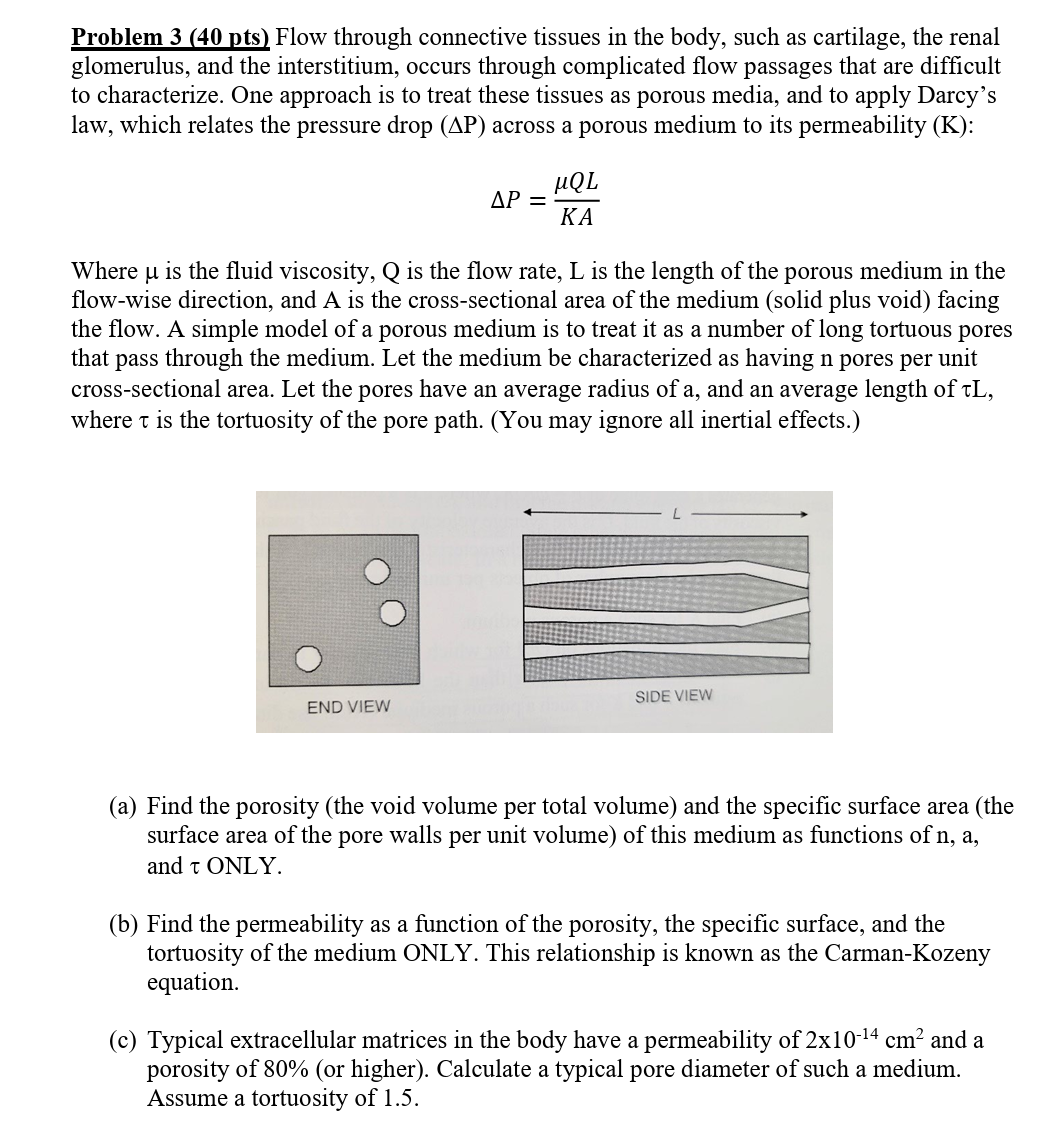
the flow. A simple model of a porous medium is to treat it as a number of long tortuous pores
that pass through the medium. Let the medium be characterized as having pores per unit
crosssectional area. Let the pores have an average radius of a and an average length of
where is the tortuosity of the pore path. You may ignore all inertial effects.
a Find the porosity the void volume per total volume and the specific surface area the
surface area of the pore walls per unit volume of this medium as functions of a
and ONLY.
b Find the permeability as a function of the porosity, the specific surface, and the
tortuosity of the medium ONLY. This relationship is known as the CarmanKozeny
equation.
c Typical extracellular matrices in the body have a permeability of and a
porosity of or higher Calculate a typical pore diameter of such a medium.
Assume a tortuosity of
Step by Step Solution
There are 3 Steps involved in it
1 Expert Approved Answer
Step: 1 Unlock

Question Has Been Solved by an Expert!
Get step-by-step solutions from verified subject matter experts
Step: 2 Unlock
Step: 3 Unlock
 Study Help