







Question: Problem 3. [40 points) For each language, either prove the language is regular (by creating an implementation with your choice of a DFA, NFA, RegEx,
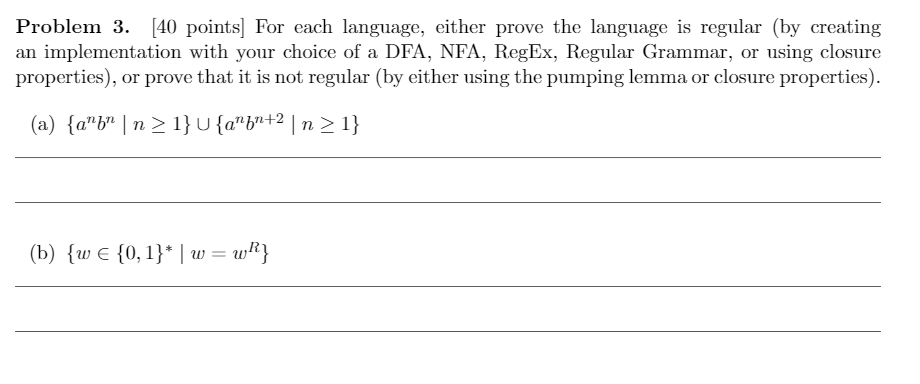
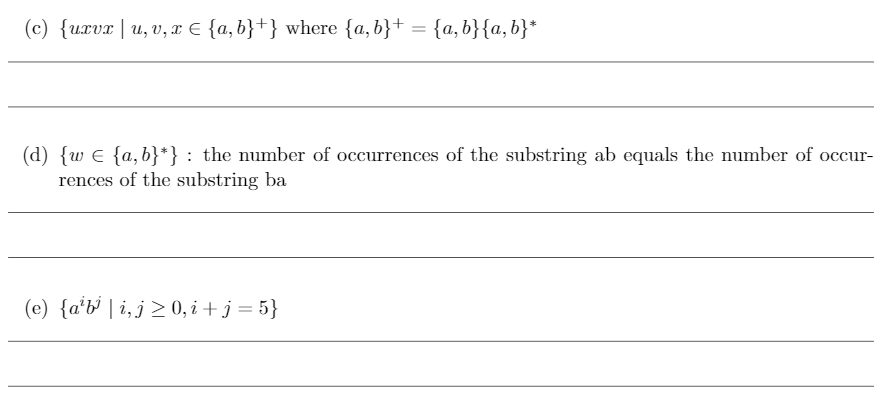
Problem 3. [40 points) For each language, either prove the language is regular (by creating an implementation with your choice of a DFA, NFA, RegEx, Regular Grammar, or using closure properties), or prove that it is not regular (by either using the pumping lemma or closure properties). (a) {a"b" | n > 1} U{abn+2 | n > 1} (b) {w {0,1}* | w = wf} (c) {uxur | U, V, XE {a,b}+} where {a,b}+ = {a,b}{a,b}* (d) {w E {a,b}*} : the number of occurrences of the substring ab equals the number of occur- rences of the substring ba (e) {a' b ij > 0,i+j = 5} Problem 3. [40 points) For each language, either prove the language is regular (by creating an implementation with your choice of a DFA, NFA, RegEx, Regular Grammar, or using closure properties), or prove that it is not regular (by either using the pumping lemma or closure properties). (a) {a"b" | n > 1} U{abn+2 | n > 1} (b) {w {0,1}* | w = wf} (c) {uxur | U, V, XE {a,b}+} where {a,b}+ = {a,b}{a,b}* (d) {w E {a,b}*} : the number of occurrences of the substring ab equals the number of occur- rences of the substring ba (e) {a' b ij > 0,i+j = 5}
Step by Step Solution
There are 3 Steps involved in it

Get step-by-step solutions from verified subject matter experts
 Study Help