







Question: Problem 3 (4+3+3=10 points). A Pd membrane is separating two very large containers, both initially empty. At time t=0, hydrogen is introduced in both containers,
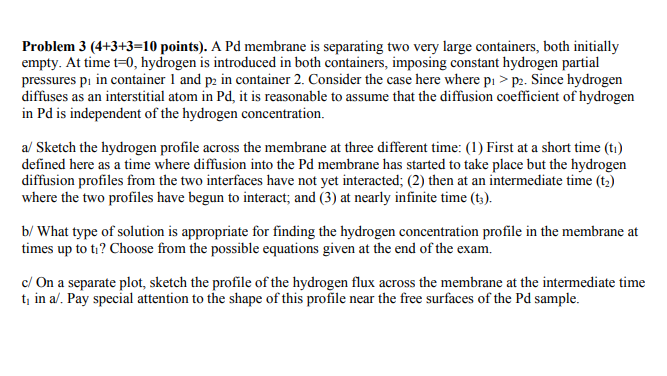
Problem 3 (4+3+3=10 points). A Pd membrane is separating two very large containers, both initially empty. At time t=0, hydrogen is introduced in both containers, imposing constant hydrogen partial pressures pi in container 1 and p2 in container 2. Consider the case here where pi > P2. Since hydrogen diffuses as an interstitial atom in Pd, it is reasonable to assume that the diffusion coefficient of hydrogen in Pd is independent of the hydrogen concentration. a/ Sketch the hydrogen profile across the membrane at three different time: (1) First at a short time (ti) defined here as a time where diffusion into the Pd membrane has started to take place but the hydrogen diffusion profiles from the two interfaces have not yet interacted; (2) then at an intermediate time (t2) where the two profiles have begun to interact; and (3) at nearly infinite time (t). b/What type of solution is appropriate for finding the hydrogen concentration profile in the membrane at times up to t? Choose from the possible equations given at the end of the exam. c/ On a separate plot, sketch the profile of the hydrogen flux across the membrane at the intermediate time t; in al. Pay special attention to the shape of this profile near the free surfaces of the Pd sample. Problem 3 (4+3+3=10 points). A Pd membrane is separating two very large containers, both initially empty. At time t=0, hydrogen is introduced in both containers, imposing constant hydrogen partial pressures pi in container 1 and p2 in container 2. Consider the case here where pi > P2. Since hydrogen diffuses as an interstitial atom in Pd, it is reasonable to assume that the diffusion coefficient of hydrogen in Pd is independent of the hydrogen concentration. a/ Sketch the hydrogen profile across the membrane at three different time: (1) First at a short time (ti) defined here as a time where diffusion into the Pd membrane has started to take place but the hydrogen diffusion profiles from the two interfaces have not yet interacted; (2) then at an intermediate time (t2) where the two profiles have begun to interact; and (3) at nearly infinite time (t). b/What type of solution is appropriate for finding the hydrogen concentration profile in the membrane at times up to t? Choose from the possible equations given at the end of the exam. c/ On a separate plot, sketch the profile of the hydrogen flux across the membrane at the intermediate time t; in al. Pay special attention to the shape of this profile near the free surfaces of the Pd sample
Step by Step Solution
There are 3 Steps involved in it

Get step-by-step solutions from verified subject matter experts
 Study Help