







Question: Problem 3 (51pt) In this problem, we will derive preferences of Household, EH, which consists of three mem- bers: A, B and C. When Household
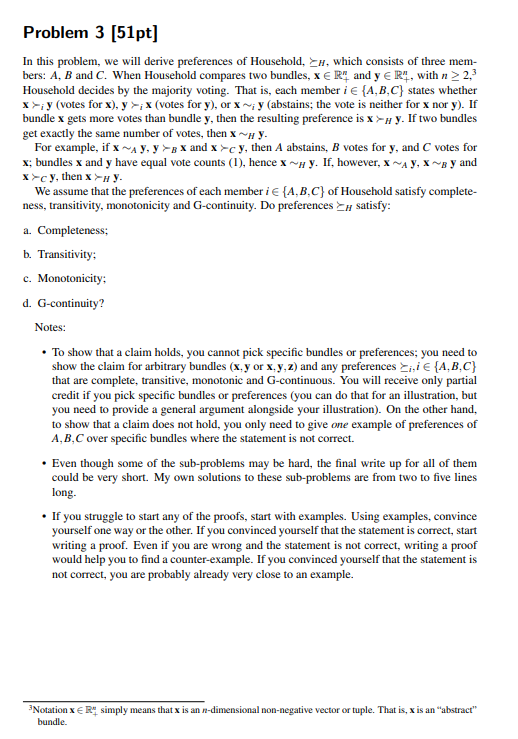
Problem 3 (51pt) In this problem, we will derive preferences of Household, EH, which consists of three mem- bers: A, B and C. When Household compares two bundles, x R4 and y R4, with n > 2,3 Household decides by the majority voting. That is, each member i {A,B,C) states whether xriy (votes for x), y >X (votes for y), or Xiy (abstains; the vote is neither for x nor y). If bundle x gets more votes than bundle y, then the resulting preference is x > y. If two bundles get exactly the same number of votes, then xy. For example, if xy, yx and x >c y, then A abstains, B votes for y, and votes for x; bundles x and y have equal vote counts (1), hence x - y. If, however, XAY, X~By and x>cy, then x >y. We assume that the preferences of each member i (A,B,C) of Household satisfy complete- ness, transitivity, monotonicity and G-continuity. Do preferences satisfy: a. Completeness: b. Transitivity: c. Monotonicity: d. G-continuity? Notes: To show that a claim holds, you cannot pick specific bundles or preferences, you need to show the claim for arbitrary bundles (x,y or x,y,z) and any preferences i,i {A,B.C} that are complete, transitive, monotonic and G-continuous. You will receive only partial credit if you pick specific bundles or preferences (you can do that for an illustration, but you need to provide a general argument alongside your illustration). On the other hand, to show that a claim does not hold, you only need to give one example of preferences of A,B,C over specific bundles where the statement is not correct. Even though some of the sub-problems may be hard, the final write up for all of them could be very short. My own solutions to these sub-problems are from two to five lines long. If you struggle to start any of the proofs, start with examples. Using examples, convince yourself one way or the other. If you convinced yourself that the statement is correct, start writing a proof. Even if you are wrong and the statement is not correct, writing a proof would help you to find a counter-example. If you convinced yourself that the statement is not correct, you are probably already very close to an example. Notation x ER simply means that x is an n-dimensional non-negative vector or tuple. That is, x is an abstract" bundle. Problem 3 (51pt) In this problem, we will derive preferences of Household, EH, which consists of three mem- bers: A, B and C. When Household compares two bundles, x R4 and y R4, with n > 2,3 Household decides by the majority voting. That is, each member i {A,B,C) states whether xriy (votes for x), y >X (votes for y), or Xiy (abstains; the vote is neither for x nor y). If bundle x gets more votes than bundle y, then the resulting preference is x > y. If two bundles get exactly the same number of votes, then xy. For example, if xy, yx and x >c y, then A abstains, B votes for y, and votes for x; bundles x and y have equal vote counts (1), hence x - y. If, however, XAY, X~By and x>cy, then x >y. We assume that the preferences of each member i (A,B,C) of Household satisfy complete- ness, transitivity, monotonicity and G-continuity. Do preferences satisfy: a. Completeness: b. Transitivity: c. Monotonicity: d. G-continuity? Notes: To show that a claim holds, you cannot pick specific bundles or preferences, you need to show the claim for arbitrary bundles (x,y or x,y,z) and any preferences i,i {A,B.C} that are complete, transitive, monotonic and G-continuous. You will receive only partial credit if you pick specific bundles or preferences (you can do that for an illustration, but you need to provide a general argument alongside your illustration). On the other hand, to show that a claim does not hold, you only need to give one example of preferences of A,B,C over specific bundles where the statement is not correct. Even though some of the sub-problems may be hard, the final write up for all of them could be very short. My own solutions to these sub-problems are from two to five lines long. If you struggle to start any of the proofs, start with examples. Using examples, convince yourself one way or the other. If you convinced yourself that the statement is correct, start writing a proof. Even if you are wrong and the statement is not correct, writing a proof would help you to find a counter-example. If you convinced yourself that the statement is not correct, you are probably already very close to an example. Notation x ER simply means that x is an n-dimensional non-negative vector or tuple. That is, x is an abstract" bundle
Step by Step Solution
There are 3 Steps involved in it

Get step-by-step solutions from verified subject matter experts
 Study Help