







Question: Problem 3. (a) 2460 m, (b) 4.56 m/s, (0) 7.06 m/s. Problem 5. (a) 156.8 m, (b) 22.4 m/s, (0) 71.7 m, ((1) 228.5 m
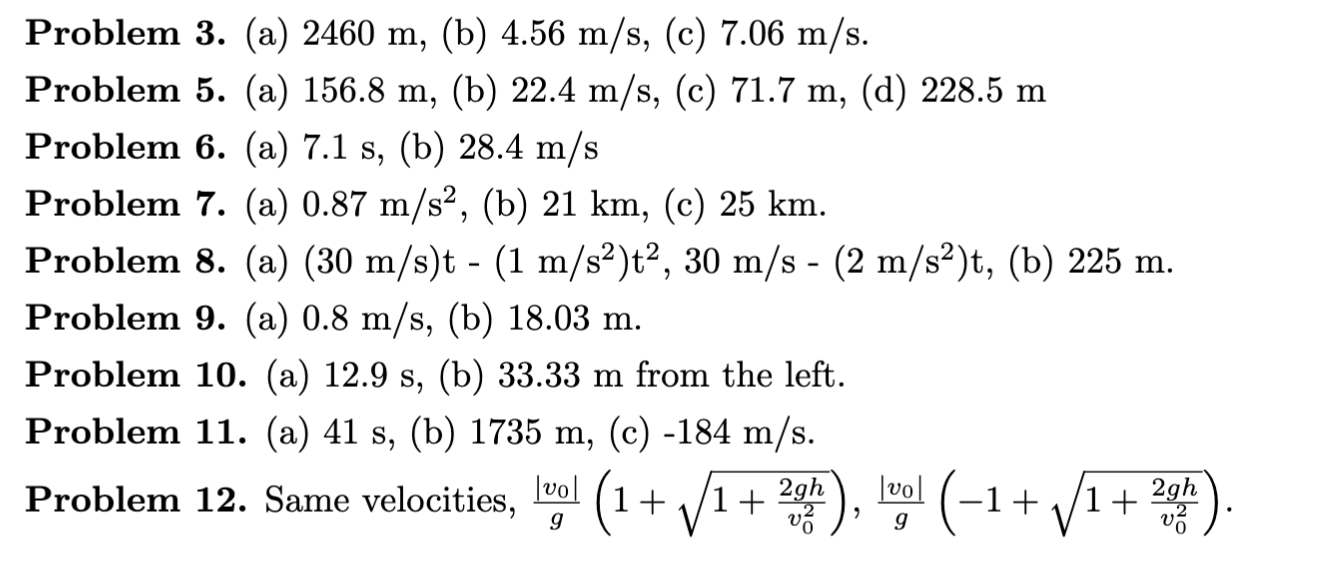
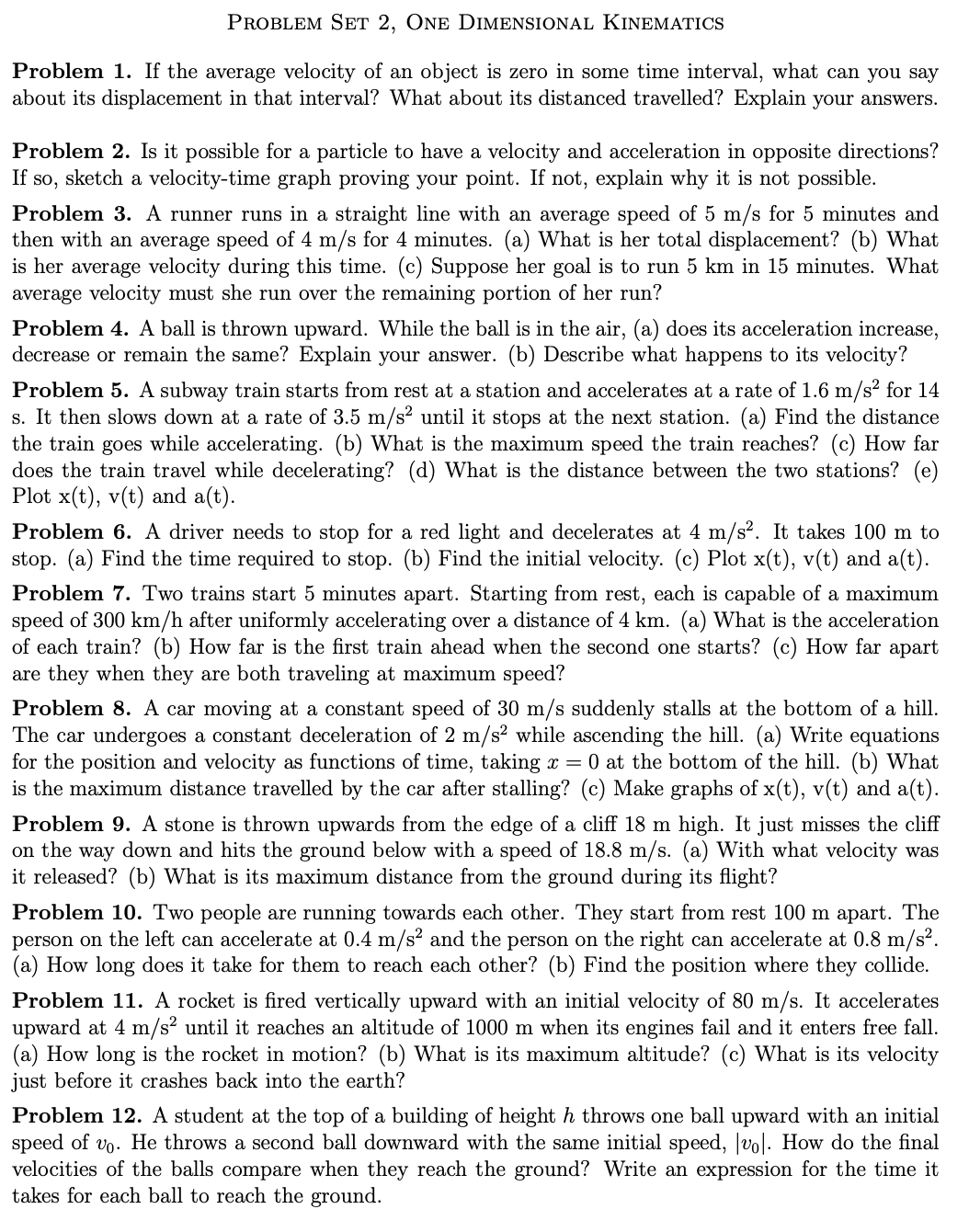
Problem 3. (a) 2460 m, (b) 4.56 m/s, (0) 7.06 m/s. Problem 5. (a) 156.8 m, (b) 22.4 m/s, (0) 71.7 m, ((1) 228.5 m Problem 6. (a) 7.1 s, (b) 28.4 m/s Problem 7. (a) 0.87 111/82, (b) 21 km, (C) 25 km. Problem 8. (a) (30 m/s)t - (1 m/S2)t2, 30 m/s - (2 m/s2)t, (b) 225 m. Problem 9. (a) 0.8 m/s, (b) 18.03 In. Problem 10. (a) 12.9 S, (b) 33.33 m from the left. Problem 11. (a) 41 s, (b) 1735 m, (c) -184 m/s. Problem 12. Same velocities, % (1 +1/1 + 132E),|v_;|(_1+1/1 + 275;). O O PROBLEM SET 2, ONE DIMENSIONAL KINEMATICS Problem 1. If the average velocity of an object is zero in some time interval, what can you say about its displacement in that interval? What about its distanced travelled? Explain your answers. Problem 2. Is it possible for a particle to have a velocity and acceleration in opposite directions? If so, sketch a velocity-time graph proving your point. If not, explain why it is not possible. Problem 3. A runner runs in a straight line with an average speed of 5 m/s for 5 minutes and then with an average speed of 4 m/ s for 4 minutes. (a) What is her total displacement? (b) What is her average velocity during this time. (c) Suppose her goal is to run 5 km in 15 minutes. What average velocity must she run over the remaining portion of her run? Problem 4. A ball is thrown upward. While the ball is in the air, (a) does its acceleration increase, decrease or remain the same? Explain your answer. (b) Describe what happens to its velocity? Problem 5. A subway train starts from rest at a station and accelerates at a rate of 1.6 m/s2 for 14 s. It then slows down at a rate of 3.5 m/s2 until it stops at the next station. (a) Find the distance the train goes while accelerating. (b) What is the maximum speed the train reaches? (c) How far does the train travel while decelerating? (d) What is the distance between the two stations? (e) Plot x(t), v[t) and a(t). Problem 6. A driver needs to stop for a red light and decelerates at 4 m/s2. It takes 100 m to stop. (a) Find the time required to stop. (b) Find the initial velocity. (c) Plot x(t), v(t) and a(t). Problem 7. Two trains start 5 minutes apart. Starting from rest, each is capable of a maximum speed of 300 km/ h after uniformly accelerating over a distance of 4 km. (a) What is the acceleration of each train? (b) How far is the rst train ahead when the second one starts? (c) How far apart are they when they are both traveling at maximum speed? Problem 8. A car moving at a constant speed of 30 m/s suddenly stalls at the bottom of a hill. The car undergoes a constant deceleration of 2 m/s2 while ascending the hill. (a) Write equations for the position and velocity as functions of time, taking :1: = 0 at the bottom of the hill. (b) What is the maximum distance travelled by the car after stalling? (c) Make graphs of x(t), v(t) and a(t). Problem 9. A stone is thrown upwards from the edge of a cliff 18 m high. It just misses the cliff on the way down and hits the ground below with a speed of 18.8 m/s. (a) With what velocity was it released? (b) What is its maximum distance from the ground during its ight? Problem 10. Two people are running towards each other. They start from rest 100 m apart. The person on the left can accelerate at 0.4 m/s2 and the person on the right can accelerate at 0.8 m/sg. (a) How long does it take for them to reach each other? (b) Find the position where they collide. Problem 11. A rocket is red vertically upward with an initial velocity of 80 m/ s. It accelerates upward at 4 m/s2 until it reaches an altitude of 1000 m when its engines fail and it enters free fall. (a) How long is the rocket in motion? (b) What is its maximum altitude? (c) What is its velocity just before it crashes back into the earth? Problem 12. A student at the top of a building of height h throws one ball upward with an initial speed of no. He throws a second ball downward with the same initial speed, |vg|. How do the nal velocities of the balls compare when they reach the ground? Write an expression for the time it takes for each ball to reach the ground
Step by Step Solution
There are 3 Steps involved in it

Get step-by-step solutions from verified subject matter experts
 Study Help