







Question: Problem 3 a. The new position and velocity after taking one step with h = 0.01 b. The position and velocity after taking another step
Problem 3
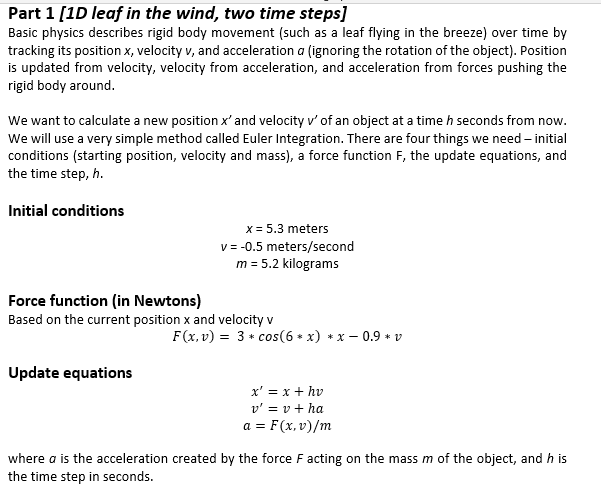
a. The new position and velocity after taking one step with h = 0.01
b. The position and velocity after taking another step (h = 0.01), but this time starting with the position and velocity calculated in part a).
c. Calculate the new position and velocity after taking one step with h = 0.02. (Use the same starting position and velocity as in part a).)
d. Does taking two steps with h=0.01 give the same answer as taking one step with h=0.02?
e. Hypothesize which is more accurate (two steps with h=0.01 or one with h = 0.02). Justify your answer.
Self check:
Part a)
Old position: 5.3000 meters, new position X.XX5X meters, time step 0.0100
Old velocity: -0.5000 m/s, new velocity -X.XX0X m/s, time step 0.0100
Part b)
Old position: X.XX50X meters, new position X.XXX3 meters, time step 0.0100
Old velocity: -X.XX0X m/s, new velocity -X.XXX3 m/s, time step 0.0100
Part c)
Old position: 5.3000 meters, new position X.XXX0 meters, time step 0.0200
Old velocity: -0.5000 m/s, new velocity -X.XX1X m/s, time step 0.0200
Part 1[1D leaf in the wind, two time steps] Basic physics describes rigid body movement (such as a leaf flying in the breeze) over time by tracking its position x, velocity v, and acceleration a (ignoring the rotation of the object). Position is updated from velocity, velocity from acceleration, and acceleration from forces pushing the rigid body around We want to calculate a new position x'and velocity v' of an object at a time h seconds from now. We will use a very simple method called Euler Integration. There are four things we need - initial conditions (starting position, velocity and mass), a force function F, the update equations, and the time step, h. Initial conditions x 5.3 meters v -0.5 meters/second m- 5.2 kilograms Force function (in Newtons) Based on the current position x and velocity v F(x, v)3 cos(6.x)x -0.9v Update equations where a is the acceleration created by the force F acting on the mass m of the object, and h is the time step in seconds. Part 1[1D leaf in the wind, two time steps] Basic physics describes rigid body movement (such as a leaf flying in the breeze) over time by tracking its position x, velocity v, and acceleration a (ignoring the rotation of the object). Position is updated from velocity, velocity from acceleration, and acceleration from forces pushing the rigid body around We want to calculate a new position x'and velocity v' of an object at a time h seconds from now. We will use a very simple method called Euler Integration. There are four things we need - initial conditions (starting position, velocity and mass), a force function F, the update equations, and the time step, h. Initial conditions x 5.3 meters v -0.5 meters/second m- 5.2 kilograms Force function (in Newtons) Based on the current position x and velocity v F(x, v)3 cos(6.x)x -0.9v Update equations where a is the acceleration created by the force F acting on the mass m of the object, and h is the time step in seconds
Step by Step Solution
There are 3 Steps involved in it

Get step-by-step solutions from verified subject matter experts
 Study Help